

A chef-prepared meal deserves better than a blast of full-power microwave. Reheat it gently, cover it, and bring it to 165°F, and the sauce turns glossy again, the rice stays tender and the roasted vegetables keep their edges. Rush it, and you get dry chicken and a cold center.
We cook every meal fresh in small batches and never freeze it, so the job at home is simple: warm the food through without cooking it a second time. Here’s how to do that with each method, each part of the plate and each kind of container.
TL;DR
- Heat every reheated meal to 165°F, checked with a food thermometer, and bring sauces, soups and gravies to a rolling boil.
- The oven (set no lower than 325°F) is best for roasted proteins, breads and anything crisp. The stovetop suits soups and stews. The microwave is fastest, but only with a cover, lower power and a short rest.
- Take the meal out of any container that isn’t labeled for heating, and use glass or ceramic for the microwave.
- Refrigerate leftovers within 2 hours and eat them within 3 to 4 days.
Table of Contents
- Check the container before you check the clock
- The number that matters: 165°F
- Reheating in the oven
- Reheating on the stovetop
- Reheating in the microwave
- Reheat each part of the plate on its own terms
- One method to skip: the slow cooker
- What to do with what’s left
- Fresh-cooked meals, ready for your own table
- A chef’s view on reheating
- Bring it to the table
- FAQ
- Sources
Check the container before you check the clock
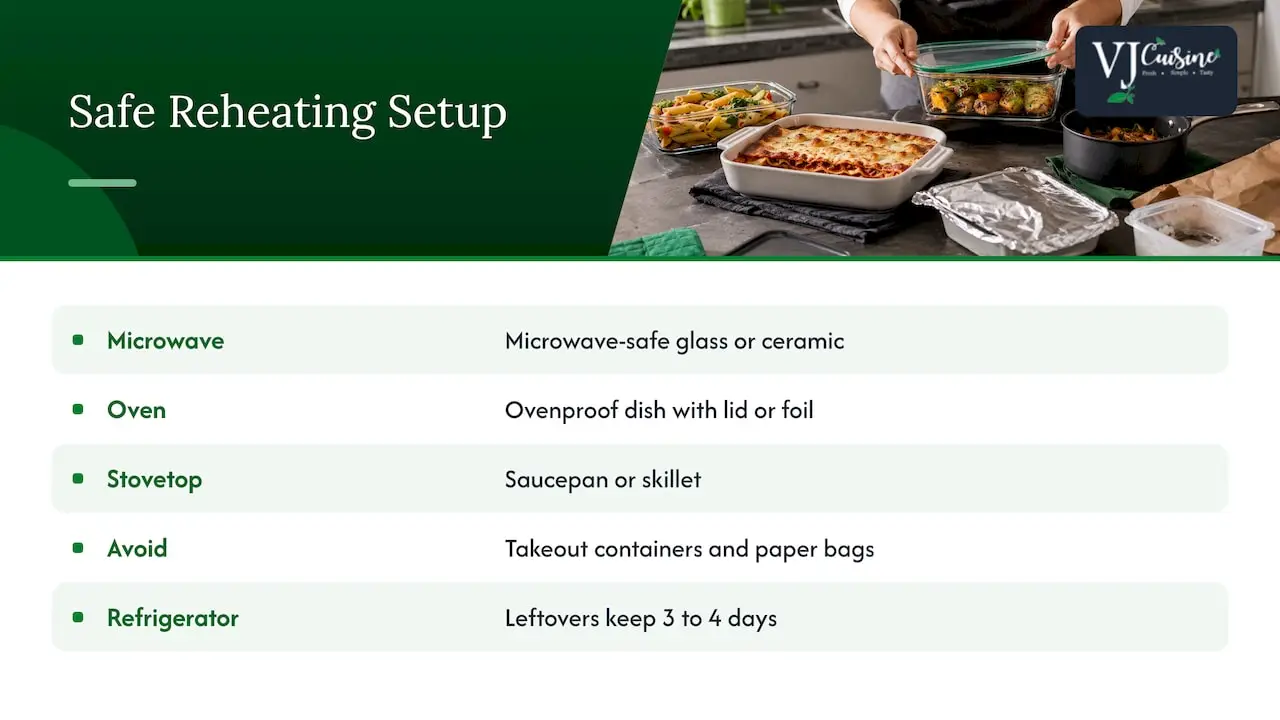
Start with the dish, not the dial. Food Network’s kitchen team warns against heating food in takeout containers that can warp or melt, and against paper bags, since the glue can give off fumes. Their fix is easy: move the food to microwave-safe glass or ceramic.
For the oven, an ovenproof dish with a lid or a sheet of foil works well. For the stovetop, any saucepan or skillet will do.
If your meal came with its own heating instructions or a label on the container, follow it first. It was written for that dish.
Also look at the storage side. Meals that have been in your fridge for more than a few days are past their best window. USDA says leftovers keep in the refrigerator for 3 to 4 days. Count from the day you received the meal, and eat the more delicate dishes first.
The number that matters: 165°F
Whatever method you choose, the target is the same. USDA’s food safety agency says reheated leftovers need to reach 165°F, measured with a food thermometer. Sauces, soups and gravies should be brought to a rolling boil.
A thermometer is a small, inexpensive tool, and it takes the guesswork out of reheating. Steam rising from the top doesn’t tell you what’s happening in the middle of a thick piece of chicken.
Here’s how to use it well:
- Insert the probe into the thickest part of the protein.
- For a casserole or grain dish, check the center and a spot near the edge.
- Don’t let the probe touch the dish, because the dish runs hotter than the food.
- If it’s below 165°F, heat another minute or two and check again.
Reheating in the oven
The oven is slower, but it’s the most forgiving. Texas A&M’s food safety program says the low, slow, even heat of the oven gives the best quality for reheated food. It’s our first pick for a proper dinner.
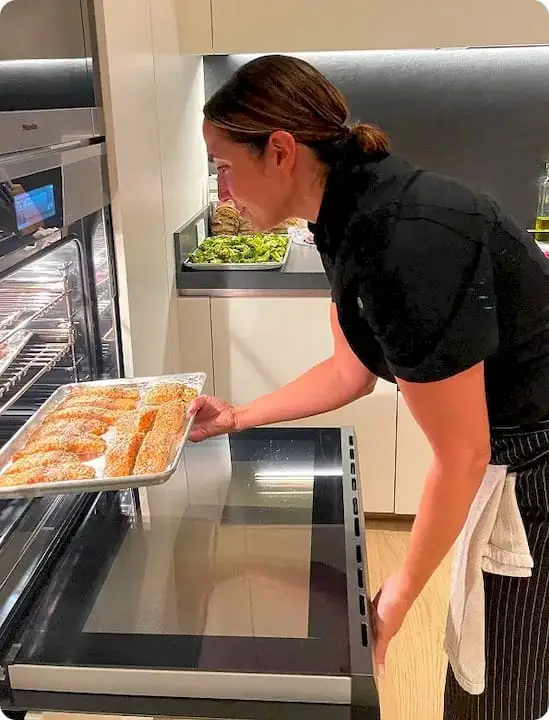
USDA’s guidance on restaurant leftovers says to reheat meat and poultry in an oven set no lower than 325°F and to confirm 165°F with a thermometer. Going lower can leave food too long in the temperature range where bacteria multiply.
Oven steps
- Heat the oven to 325°F while you take the meal out of the fridge. A few minutes on the counter takes the chill off.
- Spread the food in an ovenproof dish in an even layer. Crowded food heats unevenly.
- Add a spoonful of stock, water or the meal’s own sauce to anything that looks dry.
- Cover tightly with a lid or foil. The trapped steam keeps proteins juicy.
- Heat until the thickest part reads 165°F. A single portion of chicken thigh or fish usually needs less time than a full family tray, so start checking early.
- For a crisp finish, take the cover off for the last few minutes. Roasted vegetables, crusts and crumb coatings come back to life this way.
You’ll smell it when it’s ready: roasted garlic, warm spices, browned edges. That aroma is half the pleasure of a chef meal, and the oven is the method that protects it best.
Reheating on the stovetop
Soups, stews, braises and saucy dishes belong in a pot. Texas A&M notes the stovetop suits soups and stews as long as you stir consistently. It’s also the easiest way to meet the boil rule for sauces and gravies.
- Use a saucepan over medium-low heat. High heat scorches the bottom before the middle warms.
- Stir often and scrape the bottom.
- Bring liquid dishes to a full, rolling boil, then simmer a moment.
- Taste before serving. A pinch of salt, a squeeze of lemon or a handful of fresh herbs added at the end wakes the flavors up again.
For a plate of rice and protein, a skillet works too. Add a splash of water, put the food in, cover with a lid and let it steam gently. It’s a quick, tidy way to warm one serving without drying it out.
Reheating in the microwave
Most of us reach for the microwave on a weeknight, and that’s fine. A few habits make the difference between tender and rubbery.
Consumer Reports spoke with appliance and food experts and found that lower power levels often give better reheating results, since full power can dry food out. They also explain that food without a lid turns dry and rubbery, because the microwave makes water molecules move fast and evaporate quickly.
Microwave steps
- Move the food to a glass or ceramic dish labeled for microwave use.
- Arrange it in a single even layer, with the thickest pieces toward the outside edge.
- Add a splash of water, stock or sauce, then cover. USDA says to vent the cover so steam can escape, and to rotate the food for even heating.
- Use medium power and heat in short bursts. Food Network suggests 30-second to 1-minute intervals, stirring liquids and turning solids between rounds.
- Let it rest 2 to 3 minutes. Consumer Reports’ experts say the leftover steam and heat finish the job.
- Check the temperature in several places. USDA warns that microwaves have cold spots, so one reading isn’t enough.
Dense foods take longer than light ones. A thick piece of braised meat needs more time than a handful of sautéed greens, and rice, fish and chicken in particular do better with lower power and a little more time.
Reheat each part of the plate on its own terms
A chef meal usually has several components: a protein, a starch, vegetables, a sauce. They don’t all want the same treatment. Food Network recommends deconstructing a meal before microwaving, so each piece reaches its best texture. Here’s how that plays out.
| Part of the meal | Best method | What to do |
|---|---|---|
| Roasted or grilled protein | Oven | 325°F, covered, until 165°F in the thickest part |
| Rice, grains, couscous | Microwave or skillet | Splash of water, cover, stir halfway |
| Roasted vegetables | Oven | Uncover for the last few minutes to bring back the edges |
| Soups, stews, braises | Stovetop | Medium-low, stir often, rolling boil |
| Sauces and gravies | Stovetop | Bring to a rolling boil, then pour over |
| Breads, pita, crisp coatings | Oven | Warm uncovered so they stay crisp |
| Fresh herbs, salads, raw garnishes | None | Pick them out before heating and add at the end |
Food Network also notes that breads and crispy coated foods come out better from the oven than the microwave. Soft pita warmed in a dry skillet for a few seconds gets its pliable chew back. A garnish of fresh parsley or mint added at the table brings brightness that no reheating can.
In brief: heat the dense items first, add lighter sides partway through, and keep anything raw or leafy away from the heat entirely.
Read More: Fresh vs. frozen meals: what really differs
One method to skip: the slow cooker
It seems gentle, so a slow cooker feels like a natural choice for warming a meal. USDA’s guidance says reheating in slow cookers isn’t recommended, because food can sit too long in the 40°F to 140°F range before it gets hot enough. The same goes for chafing dishes.
If you’re serving guests, heat the food on the stovetop or in the oven first. Then, if you like, hold it hot in a preheated slow cooker or warming dish until everyone’s ready.
What to do with what’s left
Planning to eat only half of a reheated dish? Put the remainder away right away. USDA says that if you reheat a portion and don’t finish it, refrigerate what’s left immediately so it can be reheated again safely.
A few habits keep leftovers good:
- Reheat only the portion you plan to eat. Every extra trip to the stove costs texture.
- Store food in shallow, covered containers so it cools fast.
- Eat meat and poultry within 3 to 4 days of when you received it.
- Label containers with the date, using MM/DD format, so nobody has to guess.
If you cook ahead for a new baby, a busy month or a big family week and want to use your freezer, this freezer plan with storage and reheating tips walks through how to portion and label meals.
There’s one more point worth knowing. Our meals are never frozen before they reach you, so you aren’t reheating something that’s already been through a freeze and thaw cycle. You’re simply warming food that was cooked fresh.
Read More: Small-batch cooking in Miami: four chef formats for busy families
Fresh-cooked meals, ready for your own table
If your week is packed, a weekly rotation of chef-cooked dinners takes the cooking off your plate and leaves you only the warming. Our chef-crafted meal plans are prepared fresh in small batches by Chef Virginia, with menus that feature a variety of cuisines and quality ingredients. We talk through dietary needs with you before you order, and we deliver across Miami and South Florida, including Brickell, Coral Gables, Coconut Grove, Pinecrest, Key Biscayne, Miami Beach and Aventura.
If you’d like a chef at your table for a special evening, or catering for a gathering, we do that too. Tell us what you have in mind and we’ll shape a menu around it.
A chef’s view on reheating
When I cook for a family, I’m thinking about the second meal as much as the first. A braise is just as good, sometimes better, the next day. A pot of Lebanese-spiced rice wants a little steam and a lid. A sauce wants to come back to a boil and a squeeze of lemon.
I was born in Haiti and raised within Lebanese heritage traditions, and I’ve cooked as a private chef for Miami families for more than a decade. In that time I’ve learned that reheating is mostly about patience. Low heat, a cover, a splash of liquid and a thermometer will carry you most of the way.
Everything we make is cooked fresh in small batches and never frozen. That means the food comes to you with its texture intact, and your job is to treat it kindly. We also talk through dietary needs with every client before they order, so the plate you’re warming up is one that was planned for you.
Virginia Jiha
Bring it to the table
Reheating well comes down to a handful of habits: a safe container, a gentle method, a cover, a little moisture and a thermometer reading of 165°F. Do those, and a meal on night three can still smell and taste like the night it was cooked.
When you’d rather have the cooking done for you, VJ Cuisine is ready to put fresh, chef-cooked meals on your table. Reach out to start a conversation about meals for your household.
Read More: Vetted chef-crafted family meal plans
FAQ
Can I reheat chef-prepared meals more than once?
It’s best to reheat only what you’ll eat in one sitting. USDA advises that if you don’t finish a reheated portion, you should refrigerate the rest right away so it can be reheated safely again. Each round dries the food out a little, so smaller portions taste better.
How do I keep chicken or fish from drying out?
Cover it and add a little liquid. In the oven, use a lid or foil at 325°F. In the microwave, use lower power, a vented cover and a 2 to 3 minute rest. Check for 165°F in the thickest part so you don’t overshoot.
Is it safe to reheat food straight from the freezer?
Yes. USDA says frozen leftovers can be reheated without thawing, using a saucepan or microwave for soups and stews, or the oven or microwave for casseroles. It just takes longer, and it still needs to reach 165°F.
How long can I keep a chef meal in the fridge?
USDA’s guidance says leftovers keep for 3 to 4 days in the refrigerator, and that cooked meat and poultry should go into the fridge within 2 hours of serving. Eat more delicate dishes first and keep everything covered.
Sources
- Leftovers and Food Safety, USDA Food Safety and Inspection Service
- 10 Smart Tips to Keep Your Restaurant Leftovers Safe, USDA
- Expert Tips for Microwaving Your Food Properly, Consumer Reports
- How to Reheat Leftovers in the Microwave, Food Network
- Storing Leftovers Safely, Texas A&M Dinner Tonight