
Griot (pronounced gree-oh, and spelled griyo in Haitian Creole) is Haitian pork shoulder cut into chunks, marinated in citrus and herbs, simmered until tender, then fried until the outside is crisp and caramelized. Food Network Kitchen and many Haitian cooks treat it as one of the country’s national dishes. It is the plate you see at parties, holidays and Sunday tables, almost always with a pile of tangy pikliz beside it.
If you have heard the word at a Haitian restaurant, a family gathering or a Miami food truck and want to know what you are about to eat, this guide covers what griot is made of, why it is cooked twice, what it tastes like, what goes with it and how it differs from its cousin tassot.
TL;DR
- Griot is Haitian pork shoulder, soaked in sour orange and lime, marinated in epis (a green herb seasoning), simmered, then deep-fried.
- The result is crisp and caramelized outside, tender inside, with bright, spicy, citrusy flavor rather than a heavy sweet glaze.
- It is traditionally served with pikliz (a spicy pickled slaw), fried plantains, and often rice and beans.
- Tassot is the sibling dish, made with goat or beef instead of pork, and it is chewier and denser.
- Griot is a celebration dish, which makes it a natural fit for a private dinner or an event menu.
Table of Contents
- What griot is, in plain words
- How griot is made
- What griot tastes like
- What griot is served with
- Griot vs. tassot
- Why griot suits a celebration table
- Bringing Haitian flavors to your own table in Miami
- How to enjoy griot the first time
- A note on the Haitian-Lebanese kitchen
- Our perspective
- FAQ
- Sources
What griot is, in plain words
Griot is a twice-cooked pork dish. Cooks take pork shoulder, a well-marbled cut that stays juicy through long cooking, and cut it into bite-size cubes. The pork is flavored with citrus and a seasoning paste, cooked gently in that flavored liquid until it is tender, and then fried in hot oil to finish.
The name has several spellings. You will see griot, griyo (the Haitian Creole spelling) and grillot. They all point to the same dish: pork cubes simmered with chiles and citrus, then fried, as The New York Times describes it. Haitian Creole is the language most Haitians speak at home, so “Creole griot,” a phrase people often search, simply means griot as Haitians themselves name and cook it.
In Haiti it belongs to the family of fried foods called fritay, the street-stand and party plates built around fried meats, fried plantains and pikliz.
How griot is made
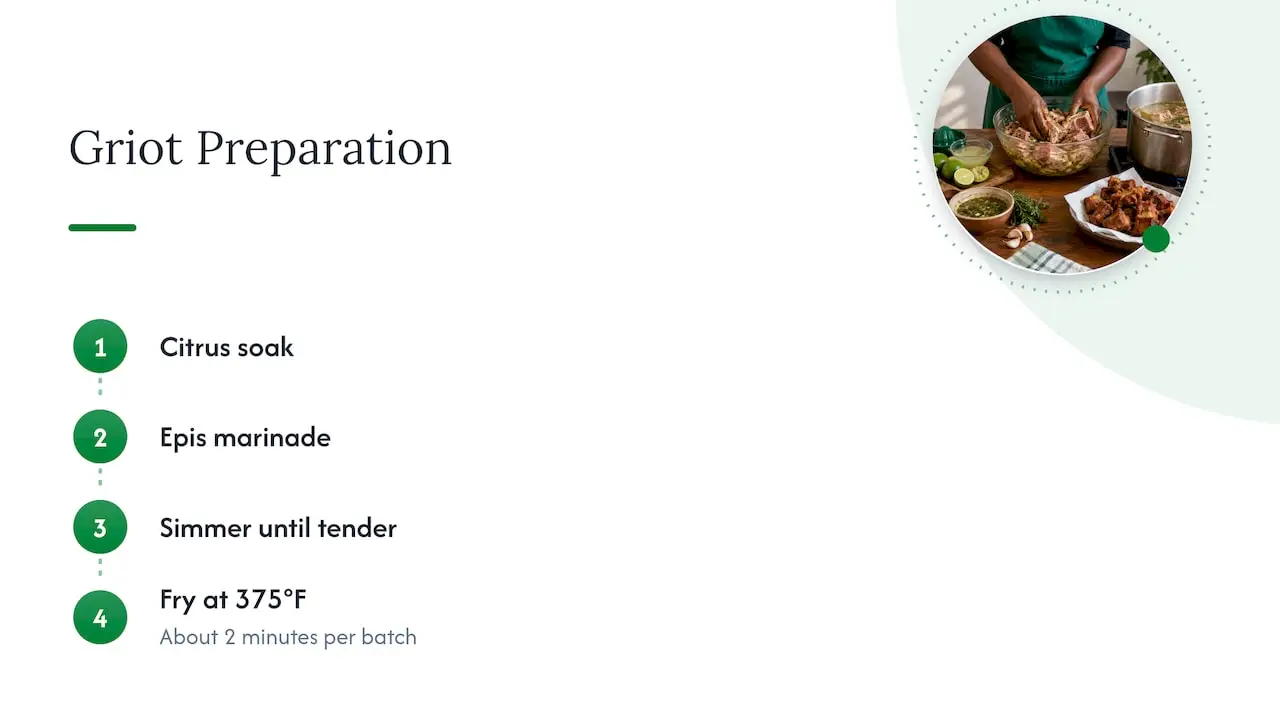
The dish has four stages. Each one explains something about the flavor.
1. The citrus soak
The pork is first washed and soaked in citrus. Food Network Kitchen’s version uses a brine of sour orange juice, lime juice, vinegar and salt. Sour orange (also sold as Seville orange) is the traditional choice, and its sharp acidity seasons the meat and brightens everything that follows.
2. The epis marinade
Next comes epis, the green seasoning that sits at the base of much Haitian cooking. The same recipe lists bell peppers, scallions, garlic, onion, shallot, Scotch bonnet pepper, celery, cilantro, parsley, culantro and olive oil, and it marinates the pork for 8 hours or overnight. If you want to understand why epis matters so much, our guide to Haitian spices, epis and cloves walks through what goes into it.
3. The simmer
The pork is then cooked in its marinade until tender. In that recipe it takes about 1 hour 10 minutes. The New York Times points out that this reverses the classic French approach of searing first: here the meat is simmered first and browned afterward, which is why the flavor stays bright and spicy from the citrus and chiles instead of turning deeply roasted.
4. The fry
Finally the pieces are drained, dried and fried. Food Network Kitchen fries at 375°F for about 2 minutes per batch, until the pork is a deep caramel brown. The goal is a crackling exterior around a meltingly tender center.
Timing is the craft. Chef Gregory Gourdet describes griyo as deceptively simple: pork cooked too long turns mushy and will not hold up to frying, while pork cooked too little stays chewy and unrendered. That is why a well-made plate of griot reads as the work of an experienced hand.
What griot tastes like
The first impression is texture. Edges are crisp and slightly caramelized, the middle is soft, and each cube is rich with pork fat. The second impression is brightness: citrus, garlic, herbs and the fruity heat of Scotch bonnet pepper. The New York Times describes the result as deeply flavored, crisp-edged meat with a melting center and a sauce that is bright and spicy from the citrus and chiles.
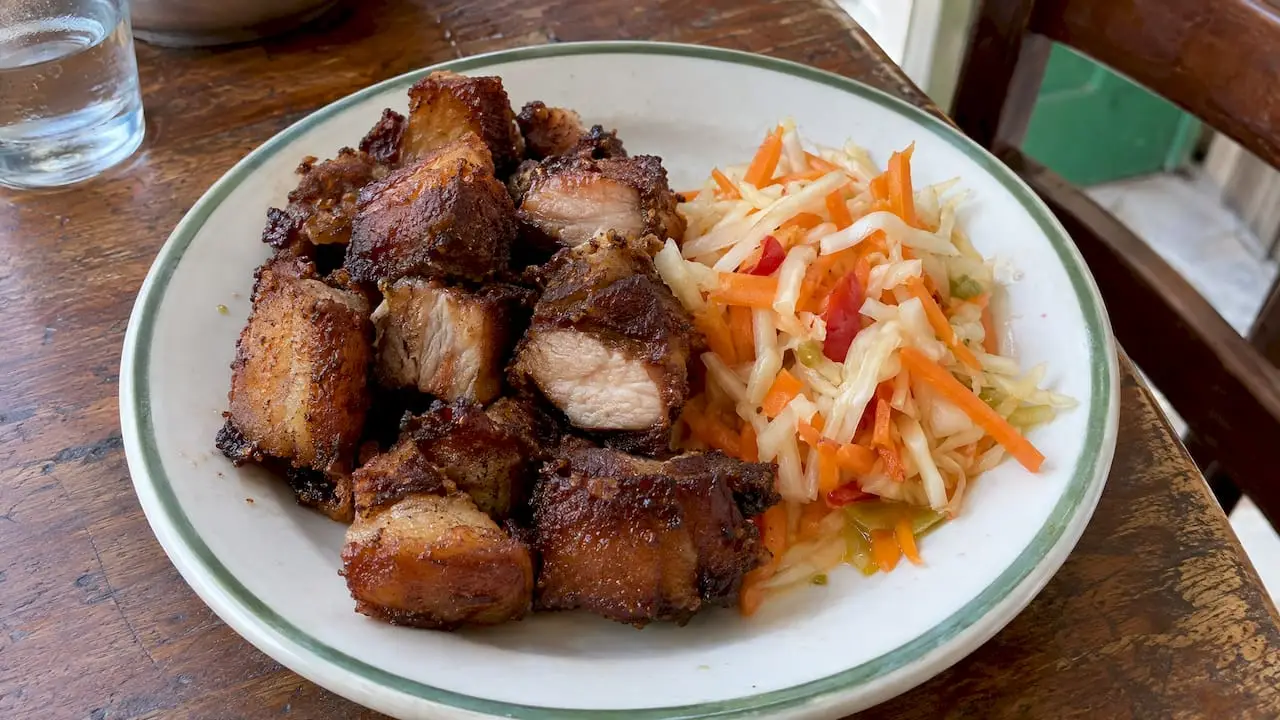
It is not a sweet dish, and it is not a barbecue-style dish. Think savory, tangy and herbal with a heat that builds, balanced by something cool, crunchy and acidic on the side. That something is pikliz.
If you are cautious about spice, the heat comes mainly from Scotch bonnet, so it can be dialed up or down by a cook who is preparing the dish for you. Heat level is one of the first things to settle when you plan a menu.
What griot is served with
Griot is rarely served alone. A traditional plate usually includes:
- Pikliz: a slaw-like pickle of cabbage, carrots, bell peppers and Scotch bonnet chiles, submerged in vinegar. The New York Times notes it cuts through the richness of fried foods; see the pikliz description. Our own guide covers how to keep pikliz crunchy and store it safely.
- Fried plantains: bannann peze, plantains fried, pressed flat and fried again for a crisp, starchy side.
- Rice and beans: often diri ak pwa wouj, red beans and rice.
- Sòs ti-malis: a spicy sauce, traditionally built from the pork’s cooking liquid.
Food Network Kitchen notes that griot is a favorite for parties, special occasions and holidays like Christmas. It also appears on a fritay platter with other fried foods such as tassot, plantains and fritters.
Griot vs. tassot
Tassot (also spelled tasot or taso) is the dish most often confused with griot, because it sits beside it on the same plate and is flavored with the same citrus and epis. The difference starts with the meat.
| Griot | Tassot | |
|---|---|---|
| Meat | Pork shoulder | Goat (tassot kabrit or cabri) or beef (tassot bèf) |
| Flavor base | Sour orange, lime, epis | Citrus, epis, hot peppers, cloves |
| Texture | Crisp outside, soft and juicy inside | Denser and chewier, with a firm fried crust |
| Typical use | Parties, holidays, Sunday meals | Parties, holidays, fritay plates |
The Haitian Times describes tassot as a marinated meat, often goat or beef, and traces it to a preservation method from Haiti’s tropical climate, where meat was briefly dried after marinating before frying. That drying step is part of why tassot is chewier and more concentrated than griot.
A simple way to remember it: griot is the juicy pork, tassot is the chewy goat or beef. Both are fried, both come with pikliz, and both are at home on a celebration table. If you are building a menu for guests, offering one of each lets people compare.
Why griot suits a celebration table
Griot is hard to make casually. It takes an overnight marinade, a careful simmer and a last-minute fry, and the fry is best done close to serving so the crust stays crackling. That is exactly why it shows up at parties and holidays: it rewards effort and is usually cooked in generous batches.
For a host, that creates a problem. Cooking griot for a dinner party means managing hot oil and timing while guests arrive. The pork has to be tender but not falling apart, the pikliz has to be made ahead so it can rest, and the plantains need two rounds of frying. Most hosts would rather sit down at the table.
Bringing Haitian flavors to your own table in Miami
VJ Cuisine is a Miami private chef service with a Haitian-Lebanese culinary heritage. Chef Virginia designs and prepares every menu herself, using fresh ingredients in small batches, and the food is never frozen. Clients talk directly with the chef, so menus can be shaped around personal tastes and dietary needs.
That matters for a dish like griot, where details such as heat level, portion size and side dishes change how a table experiences it. Here is where each of our services fits:
- A special evening at home: a private chef dinner in Miami brings a chef-crafted menu to your own dining room, which suits couples and small celebrations.
- Weekly eating: our Miami meal plans deliver fresh, ready-to-eat meals for busy professionals and families.
- Events: our boutique catering is built for small gatherings with chef-crafted menus.
- Gifts: handcrafted culinary gifts, including corporate holiday gifts, are delivered across Miami.

Tell us about your guests, your dietary needs and how much spice they enjoy, and we will plan the menu from there. You can start from our home page.
How to enjoy griot the first time
If you are trying griot for the first time, a few habits help.
- Take pikliz with every bite or two. It is meant to cut the richness. If it is very hot, take a small amount first.
- Eat it while it is hot. The crust is at its best straight from the fryer.
- Add the starch. Plantains or rice balance the tang and spice.
- Ask about heat. Scotch bonnet gives fruity, serious heat, and a cook can adjust it.
- Share a plate. Griot is a communal dish, traditionally passed around at gatherings.
A note on the Haitian-Lebanese kitchen
Haitian cooking draws on African, French, Arab, Spanish and indigenous Taino influences, according to The Haitian Times. That layered history is the reason Haitian and Lebanese flavors pair so naturally: both love garlic, herbs, citrus and bright acidity. If you are curious how the two traditions meet in one kitchen, read about Haitian-Lebanese cooking or the broader idea of cultural fusion cuisine.
Our perspective
Griot is a dish about patience and balance. The citrus soak, the epis, the gentle simmer and the quick, hot fry each do a different job, and if one is rushed the whole plate suffers. That is how we think about cooking in general.
In our kitchen, the menu is designed and prepared by one chef, in small batches, with fresh ingredients and nothing frozen. Haitian and Lebanese traditions both taught us that food is for sharing, and that the best meals come from knowing the people at the table.
That is why we talk with our clients directly. A family that loves heat, a couple who want a quiet anniversary dinner and a busy professional who needs a week of dependable meals all need different menus, and the way to get each one right is a real conversation with the person cooking.
If you want Haitian flavors, Lebanese flavors or a mix of both on your table, tell us what you love and we will build from there.
Virginia Jiha
FAQ
What does griot mean?
In food, griot is the Haitian dish of fried, citrus-marinated pork. The Haitian Creole spelling is griyo, and you may also see grillot. When someone asks for griot at a Haitian restaurant, they are ordering twice-cooked pork shoulder, usually with pikliz and plantains.
What does griot taste like?
It is savory, tangy and herbal, with a crisp, caramelized outside and a tender inside. The citrus and Scotch bonnet give it brightness and heat, and pikliz adds a sharp, crunchy contrast. It is not sweet.
What is the difference between griot and tassot?
Griot is made with pork, while tassot is made with goat or beef. Both are marinated in citrus and epis and then fried, but tassot is dried briefly before frying, so it comes out denser and chewier than griot’s juicy, tender pieces.
Is griot the national dish of Haiti?
It is widely described as one of Haiti’s national dishes, often alongside red beans and rice. Food Network Kitchen calls it one of the country’s national dishes, and it is a staple of parties and holidays.
Is griot cooked once or twice?
Twice. The pork is simmered in its marinade until tender, then deep-fried. The two stages give griot its signature contrast of tender interior and crisp exterior.
Sources
- Griot Recipe, Food Network Kitchen
- Haitian Griot Is a Postcard From the Caribbean, The New York Times
- How Gregory Gourdet Made a New Home for Haitian Cuisine, Food & Wine
- 7 unique Haitian dishes to try this holiday season, The Haitian Times