A tasting menu at home works when you serve five or six small courses, move from light to rich and back to light, and design the whole evening around what your kitchen and your schedule can actually handle. You can cook it yourself with a lot of make-ahead planning, or hand the cooking to a private chef and sit at your own table. This guide covers both, with a sample menu, portion guidance, a pacing plan and the questions to settle before a chef comes to your home.
TL;DR
- Aim for five or six courses at home. Restaurants run longer, but a home version stays manageable at that length, according to HowStuffWorks.
- Shape the meal like a bell curve: light openers, one richest peak, then a gentle sweet finish.
- Design backward from your kitchen: count burners, mix cold and make-ahead courses with only one or two last-minute plates.
- Keep portions to a few bites, and make sure there is enough food to go with every drink you pour.
- Tell your guests’ dietary needs to the chef (or plan them yourself) before you write the menu, not after.
Table of Contents
- What a tasting menu at home really is
- How many courses should you serve?
- Build the menu like a bell curve
- A sample six-course menu
- Tasting menu ideas by theme
- Portions: smaller than you think
- Pace the evening so the host sits down
- Wine and drinks with a tasting menu
- Adapt the menu for dietary needs
- When to hire a private chef for a tasting menu
- Our perspective on the home tasting menu
- Let us cook your tasting menu
- FAQ
- Sources
What a tasting menu at home really is
A tasting menu is a multicourse meal built from several small servings that show off a cook’s ideas, technique and seasonal ingredients. HowStuffWorks notes that restaurant versions can run from four to 20 or more courses, and that dishes often follow what is in season.
At home, the number matters less than the experience. Your guests are not there for a technical showcase. They are there for a slow, paced dinner where each plate arrives with a short story: what it is, why it follows the last one, and what to taste for.
Three things separate a home tasting menu from a regular dinner party:
- Portion size. Each course is a few bites, not a plate.
- Sequence. Every dish is placed on purpose, so the flavors build rather than compete.
- Pace. Courses arrive with enough time between them for conversation.
How many courses should you serve?
Five or six is the sweet spot for a first attempt. HowStuffWorks recommends that range for a home version, and the reasoning is practical: every extra course adds another plate to cook, plate and clear, and the host is the one doing it.
Here is how we think about the count:
| Courses | Best for | What to expect |
|---|---|---|
| 4 | A couple, a weeknight, a first try | Opener, main, cheese or fruit, dessert. Relaxed and short. |
| 5 to 6 | Birthdays, anniversaries, 4 to 8 guests | The classic arc: two light starters, a middle course, a peak, a sweet finish. |
| 7 to 8 | A chef-run dinner with help in the kitchen | Needs a second set of hands, a firm timeline and a lot of prep done in advance. |
If you are cooking alone, stay at the low end. If a chef is cooking for you, a longer menu is realistic because the chef brings the prep, the equipment knowledge and the rhythm of service.
Build the menu like a bell curve
The most useful structural idea for a home cook is the bell curve. As Eater reports it, chef Naomi Pomeroy starts with lighter dishes, builds toward the richest, most substantial course, and then eases down into a sweet finish.
That gives you a simple rule: decide your peak first. It is usually a braised or roasted dish, something with depth. Then work outward from it.
- Before the peak: bright, acidic, raw or lightly cooked dishes that wake the palate up without filling anyone.
- The peak: one course with the most richness, fat or intensity. Only one.
- After the peak: something cooling or fresh, then dessert that is lighter than you think it should be.
The Auguste Escoffier School of Culinary Arts makes a related point: each dish has to work on its own and as part of the whole, which means a tasting menu is not a collection of your favorite recipes. If two dishes share the same dominant flavor or texture, one of them goes.
Do a test run
The same school suggests repeated tastings and a willingness to reorder courses. At home, that means cooking the two riskiest dishes a week early and tasting them back to back. You will learn quickly whether the richest course really belongs fifth, or whether your “light” starter is secretly heavy.
A sample six-course menu
Here is a worked example with a Miami accent, the kind of menu we would build for a table of six. It is a template, not a fixed offer: swap ingredients to match the season and your guests.
| Course | Dish idea | Role in the arc |
|---|---|---|
| 1. Amuse | Citrus-marinated olives or a single oyster with a pikliz-style vinegar slaw | Bright. Wakes the palate. |
| 2. Cold | Chilled cucumber and yogurt soup with mint and olive oil | Cool, light, make-ahead. |
| 3. Seafood | Seared scallop with a charred-lemon and herb sauce | Delicate, quick to cook. |
| 4. Warm | Small kibbeh with a tahini and pomegranate drizzle | Warm, spiced, comforting. |
| 5. Peak | Slow-braised lamb or short rib with rice and a bright herb salad | Richest dish of the night. |
| 6. Finish | Citrus sorbet, then a small dark chocolate and cardamom bite | Light, sweet, closing. |
A few notes on why it works. Courses 2 and 6 are fully make-ahead. Course 5 is braised, so it improves when cooked the day before. That leaves only courses 1, 3 and 4 needing real attention on the night, and course 1 takes minutes.
Another structure you will see in home guides is a simple five-part flow from bright to warm to fresh to deep to soft. It is the same principle in different words: contrast first, depth in the middle, softness at the end.
Tasting menu ideas by theme
A theme gives you a filter, and a filter makes decisions easier. Four that work well at home:
- Coastal and citrus. Ceviche, grilled shrimp, a fish course with a bright sauce, key lime for dessert. If you want to go deeper on fish, our guide to a seafood dinner at home covers buying, cooking and serving.
- Mediterranean. Mezze-style openers, a grain or vegetable course, slow-cooked lamb or chicken, honey and nuts to finish. Our Mediterranean dinner party plan shows how to prepare most of it ahead.
- Caribbean and Levantine crossover. Spiced pikliz against creamy labneh, plantain and tahini, grilled meats with herbs. This is the territory of our own heritage, and the contrasts of acid, heat and cream suit a multi-course format very well.
- Vegetable-forward. Roasted, pickled and raw preparations from one or two seasonal vegetables, with a single protein as the peak.
If the evening is romantic rather than a group dinner, a smaller menu paced for two is the better format. Our romantic dinner at home plan walks through that.
Portions: smaller than you think
The most common mistake is plating too much. By course four, guests who ate generously at course one are full and politely pushing food around.
A few anchors:
- For very rich proteins, go tiny. Serious Eats recommends a portion of one to two ounces per person for high-fat beef such as Japanese A5 Wagyu, to keep guests from being overwhelmed.
- Cold and light courses can be a spoonful or two.
- The peak course can be the largest, but it is still a modest portion by dinner standards.
- Offer bread or a small side only if it fits the menu; do not use it to fill gaps.
If you are unsure how much of each ingredient to buy, our catering portions per person guide gives practical planning numbers you can scale down for small plates. For a more casual first course, our list of cocktail party hors d’oeuvres can also seed ideas for your opening bites.
Pace the evening so the host sits down
A tasting menu fails at home for one reason more than any other: the host is in the kitchen the whole night. The fix is to design backward from your equipment and your hands.
Start with your kitchen
Count your burners and oven racks before you pick dishes. If the peak course uses the oven, the finishing courses should not. Mix cold and make-ahead courses with a few last-minute ones, which is the approach the home-cooking blog Culinary Crush also recommends. If you are short on tools, a kitchen essentials checklist can help you spot what is missing before the night.
Use ingredients more than once
Professional kitchens save time by using one ingredient in several dishes. Food & Wine reports this strategy from chefs John and Tamar Adler, who also suggest splitting small prep jobs among several helpers. A lemon can become a marinade in course one, a sauce in course three and a zest garnish at dessert. Herb stems flavor the braise, the leaves finish the salad.
Run a timeline
Write the evening on one page, working backward from the time guests sit down. Our dinner party timeline guide explains how to build in a 30 minute buffer, which is what keeps one late dish from delaying everything after it.
A sample rhythm for a six-course dinner served at 7:30 p.m.:
- Two days before: shop, make the braise base, pickle anything that needs time.
- The day before: finish the braise, make cold soup and sorbet, prep sauces.
- Morning of: cut garnishes, set the table, label every plate or bowl you will use.
- Two hours before: reheat the braise gently, chill the soup, arrange the plating station.
- During service: leave about 10 to 15 minutes between courses so guests can talk and the next plate is not rushed.
Wine and drinks with a tasting menu
Treat drinks as part of the menu, not a separate event. Pour small amounts, match the intensity of the wine to the course, and slow down when the peak arrives. Food & Wine editors call out not serving enough food alongside wine as a major hosting error, and the same applies here: if a pairing is poured, the course should be on the table soon after.
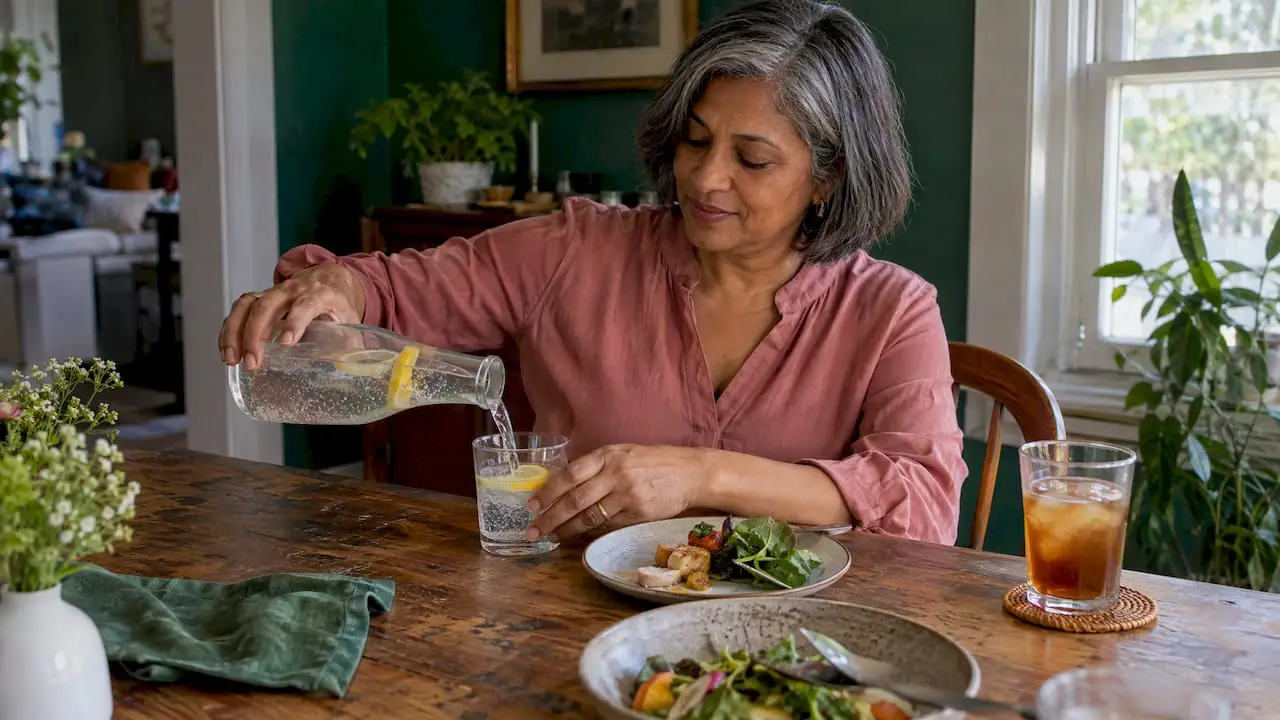
For a group, a simpler route is one sparkling or crisp white for the first half, one red or aromatic wine for the peak, and a non-alcoholic option that is as thoughtful as the rest. Sparkling water with citrus and herbs, or a chilled tea, gives non-drinkers something that belongs on the table.
Adapt the menu for dietary needs
Ask your guests about allergies and restrictions at the time you invite them, not on the night. A tasting menu is more forgiving than a buffet in one way: every course is small, so swapping one is easier than rebuilding a whole plate.
Practical rules:
- Plan the base menu so most courses are naturally compatible. Cold soups, grilled fish, vegetable courses and fruit-based desserts can often be made gluten-free or dairy-free from the start.
- Avoid cross-contact. Use clean boards and utensils, and keep allergen-free dishes plated first, away from anything with the allergen.
- Do not serve a single sad plate. A guest with restrictions should get a full tasting experience, with a real substitute for each course rather than the same salad four times.
- Label things. A short menu card listing main ingredients lets guests decide for themselves.
- For serious allergies, tell guests exactly what is in each dish and let them decide; if someone has a medically diagnosed allergy, ask what they need and follow it.
If a guest keeps a keto or low-carb diet, our keto meal plan ideas show how chef-tested dishes can be built around it.
When to hire a private chef for a tasting menu
Cooking a multi-course dinner yourself is a satisfying project. It is also a lot of work, and you will not be fully at the table. A private chef makes sense when:
- The occasion matters (an anniversary, a milestone birthday, a proposal dinner).
- You are hosting six or more and do not want to cook five courses.
- Guests have several different dietary needs.
- You want restaurant sequencing without restaurant noise.
What to settle with the chef
These are the points worth discussing before the date. Ask the same questions of any chef you consider.
- Guest count and seating. Course count and plating style depend on it.
- Dietary needs and allergies. Share them in writing and ask how cross-contact is handled.
- Courses and pacing. Agree on how many courses, how long the evening should run, and when dessert lands.
- Ingredients. Ask whether the menu is built around what is fresh and in season, and where ingredients are sourced.
- Your kitchen. Tell the chef about your oven, burners, counter space and any limits, so the menu fits the room.
- Service and cleanup. Clarify whether the chef plates and serves, who brings tableware, and what the kitchen looks like afterward.
- Drinks. Decide whether you are supplying wine and whether the chef should suggest pairings.
- Budget. Ask for a written quote that lists exactly what is included.
Our perspective on the home tasting menu
We cook small-batch, never-frozen food, and that changes how we design a tasting menu. A multi-course dinner is only as good as its freshest, smallest decisions: the acid on the first bite, the temperature of the peak course, the weight of the dessert.
Two things we hold to. First, the menu should reflect the people at the table. Before we write a single course, we talk with the host about the guests, the occasion and what they actually like to eat, because a tasting menu is personal in a way a catered tray is not. Second, our Haitian-Lebanese roots make us look for contrast: something sharp against something creamy, something warm-spiced against something cool. That instinct maps perfectly onto the bell-curve structure, and it gives a menu a point of view instead of a list of nice dishes.
We would also say this to any home cook: do not try to impress with course count. Five well-paced courses will be remembered longer than nine rushed ones.
— Virginia Jiha
Let us cook your tasting menu
If you would like the evening without the prep, our private dinners are built for exactly this: Chef Virginia designs and prepares the menu, tailored to your guests and dietary needs, and you talk directly with the chef while planning. We serve homes across Miami. We do not publish prices for private dinners, so reach out through the page for a quote based on your guest count and menu.
FAQ
How many courses should a tasting menu at home have?
Five or six courses is a manageable size for most home dinners. Restaurants can serve far more, but every extra course adds plating, timing and cleanup. If you are cooking alone, four or five is a safe start.
How do I make my own tasting menu?
Pick your richest dish first, then build lighter courses before it and a gentle sweet finish after. Make sure each dish contrasts with the one before it in flavor or texture. Cook the riskiest courses once ahead of time to test the order.
How long does a home tasting menu take?
Plan on roughly two to three hours at the table for five or six courses, with 10 to 15 minutes between plates. Longer gaps tend to lose the energy of the room, and shorter ones feel rushed.
What should I tell a private chef before a tasting menu?
Share your guest count, any allergies or dietary restrictions, the occasion, your kitchen setup and your budget. Ask how the chef handles cross-contact and whether the menu will follow seasonal ingredients. A written menu and quote before the date avoids surprises.
Can a tasting menu work for just two people?
Yes, and it is often the easiest format. A four or five course menu with small portions suits a couple well, and you can focus on a few dishes done carefully rather than many done quickly.
Sources
- How to Create a Tasting Menu, HowStuffWorks
- How to Design a Tasting Menu That Flows Like a Symphony, Eater
- Building a Better Tasting Menu for Special Events, Auguste Escoffier School of Culinary Arts
- How to Cook Wagyu Beef at Home, Serious Eats
- John and Tamar Adler: Sibling Chefs’ Big Dinner Party Secrets, Food & Wine
- How to Host the Best Wine Tasting Party Ever, Food & Wine
- How to Host a Tasting Menu Dinner at Home, Culinary Crush
- Ultimate List of Kitchen Essentials for a New Home, Kitchenware Compare