
Drop-off catering means the kitchen prepares your food and delivers it, usually with simple setup, and then leaves. Full-service catering means a team stays: staff serve, manage the buffet or plated courses, handle the timeline and clean up afterward. Choose drop-off when your guests can serve themselves and you have a place to host. Choose full-service when you want to be a guest at your own event.
The difference is mostly labor, and labor is where the cost, the stress and the polish come from. This guide walks through what each style includes, how to match one to your event, which questions to ask before booking, and the food-safety details that apply either way.
TL;DR
- Drop-off catering: food is prepared, delivered and set out (sometimes in warming trays), with no staff staying to serve or clean.
- Full-service catering: staff handle setup, service, pacing and breakdown, so you can host instead of work.
- Best fit for drop-off: casual parties, office lunches, housewarmings and small gatherings with 10 to 40 guests.
- Best fit for full-service: weddings, milestone dinners, formal seated meals and any event with a tight timeline.
- Either way: ask about temperature control, allergen handling and exactly what the delivery includes.
Table of Contents
- What drop-off catering is and what it usually includes
- What full-service catering includes
- Drop-off vs. full-service at a glance
- How to choose: five questions that settle it
- Hidden costs to ask about in either option
- Food safety: what to check with any catered meal
- Matching the service to the occasion
- A simple timeline for drop-off events
- Perspective: why we approach catering the way we do
- Catering from VJ Cuisine in Miami
- FAQ
- Sources
What drop-off catering is and what it usually includes
Drop-off catering is a delivery service built around the food itself. The caterer cooks, packs, transports and delivers, then hands you a ready-to-serve meal. Depending on the caterer, the package can look like any of these:
- Basic delivery: food arrives in trays or containers, and you set it out.
- Delivery with setup: the driver or a team member places the food on your table, lights the chafing fuel and leaves serving utensils.
- Delivery with disposable or rented serviceware: plates, napkins and utensils are included, sometimes as an add-on.
What drop-off does not include is staff for the duration of the event. Nobody refills trays, clears plates, watches the clock or breaks down the table. That is exactly why it costs less and why it suits relaxed events.
Drop-off is not the same as ordering party delivery
A delivery app order and drop-off catering can look similar at your door, but they are planned differently. With catering, you agree on a menu and headcount ahead of time, choose a delivery window, and discuss dietary needs and quantities with the person who cooks. Food is portioned for a group and packed to hold its temperature. A delivery order is built for one household’s dinner, and it typically does not account for 25 guests eating over three hours.
If you are planning quantities, our catering portions per person guide helps you avoid ordering too little or buying twice as much as you need.
Pickup vs. delivery
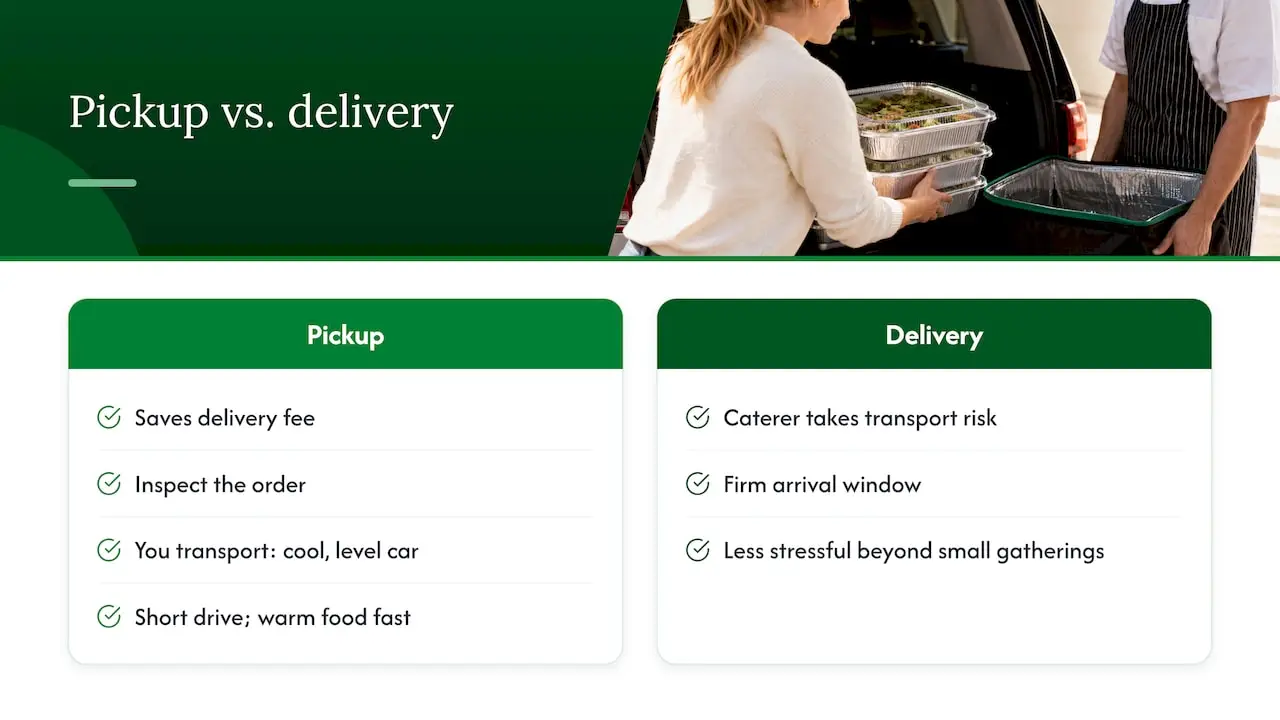
Some caterers also let you pick up an order. Pickup saves you a delivery fee and lets you inspect the order, but you become the transporter: you need a cool, level car, a short drive and a plan to get hot food into warming equipment fast. Delivery shifts that risk to the caterer and gives you a firm arrival window. For anything beyond a small gathering, delivery is usually less stressful. Policies on tipping for pickup and delivery vary by caterer, so ask when you order.
What full-service catering includes
Full-service catering covers the whole dining experience. Typical elements include:
- On-site staff: servers, a chef or cook, sometimes bartenders.
- Setup and styling: buffet tables, food stations or plated service arranged to your venue.
- Serviceware and rentals: plates, flatware, glassware, linens and tables, either from the caterer or coordinated through them.
- Event flow: timing of courses, refilling, toasts and clearing.
- Cleanup and breakdown: trash, dishes, rented equipment and the food area returned to order.
The point is not luxury for its own sake. It is that a host with 60 guests and a toast at 7:30 pm should not also be the person monitoring a trash can.
Drop-off vs. full-service at a glance
| Factor | Drop-off catering | Full-service catering |
|---|---|---|
| Staff on site | None after delivery (setup may be included) | Servers and cooks stay for the event |
| Setup | Basic, or you do it | Handled by the team, styled to your space |
| Serving | Guests serve themselves | Staff serve or manage the line |
| Cleanup | You, or minimal | Team handles it |
| Cost | Lower, since you pay mostly for food and delivery | Higher, since labor and rentals are added |
| Control over timing | You manage the pace | The caterer manages the pace |
| Best for | Casual, small, flexible events | Formal, large, high-stakes events |
| Your role | Host and organizer | Guest |
How to choose: five questions that settle it
1. How formal is the event?
A birthday lunch, a game-day gathering or a housewarming works well with drop-off. Plated dinners, weddings and anniversaries where guests expect to be served usually need staff. A formal event with self-serve trays can feel like a single sad plate of leftovers by the end of the night, even if the food was excellent.
2. How many guests are coming?
Under roughly 30 guests, a self-serve buffet is easy to manage. As the headcount grows, so do refills, lines and cleanup. At 50 or more, it is rarely realistic for a host to keep up. Treat those numbers as a rule of thumb, not a rule: a seated dinner for 12 may benefit from staff more than a buffet for 40.
3. Who will manage the food during the event?
Drop-off assumes someone in your group will keep an eye on trays, replace fuel, set out dessert and bag leftovers. If that someone is you, ask yourself whether you will enjoy the event. If a family member or co-worker has volunteered, drop-off is workable.
4. What does your venue offer?
Home kitchens, offices and many private venues are fine for drop-off. Some venues have rules about outside caterers, require insurance certificates or limit who can set up. Others have no kitchen, which affects what can be kept hot. Confirm this with the venue before choosing a service level.
5. What is your real budget?
Compare total costs, not menu prices. A drop-off quote can look much lower, but if you then rent tables, buy serviceware, hire a helper and spend a Sunday cleaning, the gap narrows. For a deeper look at how structure changes cost and pacing in a menu, see our comparison of prix fixe vs. à la carte.
Hidden costs to ask about in either option
Request an itemized quote and ask these questions. The answers matter more than the headline price:
- Delivery fee: is it flat, by distance or by time window? Is there a minimum order?
- Setup: does the driver place food on your table or leave it at the door?
- Serviceware: are plates, utensils, napkins, serving spoons and chafing dishes included? Are they disposable or returned?
- Equipment returns: if you rent chafing dishes or trays, when and how do they get picked up?
- Staffing minimums: for full-service, is there a minimum number of staff hours?
- Gratuity or service charge: is it already on the invoice, and what does it cover?
- Leftovers: how should you store them, and for how long?
- Changes: what is the deadline to adjust headcount or menu?
Write down the answers. A simple email confirmation prevents misunderstandings on event day.
Food safety: what to check with any catered meal
Whether the food is dropped off or served by staff, it travels from a commercial kitchen to your space, and that journey matters. Food-safety guidance from Louisiana State University’s open textbook notes that catering operations are generally treated as food-service establishments under the FDA Food Code, and that off-premise service calls for temperature control, safe transport, hygiene, allergen labeling, permits and compliance with local health requirements. Specific rules vary by state and locality, so a reputable caterer should be able to tell you how they meet them.
The model temperatures to know: the FDA Food Code’s thresholds, as summarized by AAA Food Handler, are 135°F or above for hot foods that need temperature control and 41°F or below for cold ones, though state adoption can vary. In practice, that means:
- Hot dishes should be kept in heated or insulated containers until you serve them.
- Cold dishes, such as salads, dips and desserts, should stay in coolers or the refrigerator until the last reasonable moment.
- Hot and cold foods should be packed and transported separately. PassMyKitchen’s catering guidance recommends checking temperatures at dispatch and on arrival, separating hot and cold items, and discarding food that has stayed in the danger zone beyond the safe time limit.
On drop-off orders, you are the one watching the clock once the food is on your table. Set a rule: anything that has been sitting out for a long stretch gets packed up rather than saved. If you are unsure, ask your caterer how long each dish can safely sit out and when to refrigerate it.
Allergens deserve the same attention. Ask how the kitchen separates gluten, nuts, shellfish and other major allergens, and whether dishes are labeled. If gluten-free is on your list, our guide to Miami catering companies with gluten-free options covers cross-contact questions to ask any caterer.
Matching the service to the occasion
Drop-off works well for
- Office lunches and team meetings.
- Family gatherings and casual birthdays. Our birthday party catering notes show how a menu can still feel special.
- Housewarmings, where a relaxed flow is the point. See our housewarming catering ideas for menus and safe serving.
- Cocktail-style parties where guests graze. Our cocktail party hors d’oeuvres guide helps with quantities.
Full-service works well for
- Weddings, rehearsal dinners and milestone anniversaries.
- Seated, multi-course dinners.
- Larger events where guests move through a program.
- Any event where you want to host fully and not touch a serving spoon.
The middle ground
Many events do not fit neatly in either box. A common compromise is drop-off with setup, or a smaller staffed arrangement: one or two servers for the first part of the event, or a chef who finishes dishes on site. If a caterer offers a hybrid, ask exactly which tasks are covered and for how many hours. Hiring a friend or a local helper to manage trays and cleanup can also bridge the gap, as long as someone is responsible for it.

A simple timeline for drop-off events
A drop-off order works best when the timing is planned around the food, not the other way around. Our dinner party timeline builds a schedule backward from serving time, and the same logic applies here:
- Confirm headcount and menu with the caterer about a week ahead, or by their stated deadline.
- Pick a delivery window 30 to 45 minutes before guests will eat, so there is time for setup without letting food sit too long.
- Prepare the space: clear a table, plan where trays go, locate outlets if you use warmers.
- Receive and check the order against your confirmation: count the trays, check labels and note allergens.
- Set out hot food last, keep cold items chilled until serving.
- Plan for leftovers: have containers ready and refrigerate promptly.
Perspective: why we approach catering the way we do
At VJ Cuisine, we do not think of the choice as drop-off versus full-service so much as how much of the event you want to hold in your own hands. Our catering is small-batch and made fresh, never frozen, and every menu is designed with you, personally, so the food is the same whether it is delivered or served.
For many Miami hosts, a well-planned delivery is the right call: a family gathering, a team lunch, a housewarming. What matters is that the chef knows your headcount, your dietary needs and your timing before the first dish is packed. A drop-off menu should be built for transport, so dishes hold their flavor and temperature on the way to you.
When the event is more formal, we talk about the service you want and build the plan around it. Our Haitian-Lebanese heritage shapes how we cook: generous, layered flavors, shared plates and hospitality that makes everyone feel looked after.
Virginia Jiha
Catering from VJ Cuisine in Miami
If you are planning a gathering in Miami, we can help you choose the right format and build a menu that fits it. Our catering service offers boutique, chef-crafted menus with fresh, small-batch food that is never frozen, tailored to dietary needs and delivered across Miami. You talk directly with the chef about your guest count, preferences and timing.
For a smaller, more personal occasion, our private dinners bring a chef-prepared meal to your home. You can also read more on planning and menus in our Miami catering blog, or see our approach to sustainable event catering if reducing waste matters to your gathering.
FAQ
What is drop-off catering?
Drop-off catering is a service where the caterer prepares the food, delivers it to your location and sometimes sets it out, but does not stay to serve or clean. You manage the event while guests serve themselves. It usually costs less than full-service because there is little or no on-site labor.
Is drop-off catering cheaper than full-service?
Usually, yes, because you are not paying for servers, bartenders or a full setup and breakdown team. Compare total costs, though. If you will need to rent equipment, buy serviceware or hire a helper, add those to the drop-off price before deciding. Ask both types of caterer for an itemized quote.
What is the difference between catering and party delivery?
Catering is planned in advance for a group, with a menu, headcount, delivery window and often dietary needs agreed with the caterer. Party delivery usually means ordering prepared food for pickup or delivery without that level of planning. Catered food is portioned and packed to travel and hold its temperature for a group.
Should you tip on a drop-off catering order?
Practices vary, so check your invoice first, since some caterers add a service or delivery charge. If it is not included, a tip for the delivery driver or the team who set up your order is a kind gesture, and you can ask the caterer what is customary. For full-service events, ask whether gratuity is already built into the staffing fee.
Can I mix drop-off and full-service?
Often you can. Many caterers offer drop-off with setup, or a limited number of staff for a set number of hours. Ask which tasks are covered, such as serving, refilling and cleanup, so you know what you are responsible for on the day.
Sources
- 9.9: Off-Premise Food Service, Food Safety and Sanitation (LSU Pressbooks)
- Food Delivery Safety Issues (AAA Food Handler)
- Catering HACCP Plan: Cover Events, Transport, and Service (PassMyKitchen)