
A sympathy meal gift works best when it asks nothing of the person receiving it. It should arrive ready to eat, suit the people in the house, come in a container nobody has to return, and land when the family actually needs it, which is often later than you would guess. This guide covers what to send, how to handle allergies and unknown tastes, when to deliver, and what to write on the card.
TL;DR
- Send a “low-decision” meal: ready to eat or simple to reheat, with no shopping, assembly or dishes to return.
- When you do not know the family’s tastes, choose mild, familiar dishes and ask about allergies and dietary or religious restrictions first.
- The first two days often bring more food than a household can eat. Days 4 to 10, or weeks two to four, can mean more.
- Keep the note short and specific, with a clear offer of a drop-off time the family can say yes or no to.
- If the family has a food tradition, a dish from that tradition can be a respectful way to honor the person they lost.
Table of Contents
- What makes a meal a good sympathy gift
- Meal ideas that work for most households
- When you do not know what the family eats
- Honoring the family’s food traditions
- When to deliver
- How to send a sympathy meal to a home or funeral home
- What to write on the card
- Our perspective on sympathy meals
- Sending a meal in Miami with VJ Cuisine
- Other ways to help besides a meal
- Common mistakes to avoid
- FAQ
- Sources
What makes a meal a good sympathy gift
Grief takes away the ability to make small decisions. A good sympathy meal removes those decisions instead of adding new ones. One funeral-industry guide describes the ideal gift as low-decision: it travels cleanly, reheats predictably and needs no extra shopping or assembly. Wirecutter’s editors make a similar point, suggesting that you put yourself in the recipient’s shoes and ask whether the gift meets a real need or simply adds another task to an overwhelming day.
In practice, that gives you a short checklist:
- Ready to eat or one-step reheating. Nobody should need to chop, season or plate anything.
- Portioned sensibly. Individual portions let people eat when and how much they can, at odd hours, without committing to a full sit-down dinner.
- Mild and familiar. This is not the moment for a daring tasting menu.
- Packaged to be kept. A container the family never has to wash and return is one less errand.
- Clearly labeled. Dish name, main ingredients (for allergies) and simple reheating notes on the lid.
Meal ideas that work for most households
The usual suggestions are hearty, forgiving comfort foods. The funeral-industry guide lists baked pasta, lasagna, soups, breakfast items and snack boxes as dependable choices. Wirecutter recommends flexible comfort foods such as lasagna, meatballs, chili, lentil soup, casseroles and meatloaf, along with quick breads, drop cookies and cakes.
Here is how those categories compare when you are choosing.
| Option | Best for | Watch out for |
|---|---|---|
| Baked pasta or lasagna | Households with visitors and mixed ages | Dairy and gluten; heavy if the family has little appetite |
| Soup or stew with bread | Small households, people with little appetite | Needs a bowl and spoon; confirm any allergens |
| Roasted chicken, rice and vegetables | Unknown preferences, mixed diets | Keep sauces on the side if you are unsure |
| Breakfast items | Out-of-town relatives staying over | Easy to overlook; works well on the morning of the service |
| Individually portioned meals | Anyone who is not eating at set times | Needs clear labels and fridge space |
| Snack box with fruit and baked goods | Funeral homes, offices, wake gatherings | Choose items that keep without refrigeration |
Breakfast is an underrated choice. Krause Funeral Home suggests an egg dish, bagels with cream cheese or pastries in place of lunch or dinner, and ready-to-eat deli foods with pre-cut vegetables and fruit. Most people who send dinner never think of the morning, and the morning is often when relatives are underfoot and nobody has cooked.
When you do not know what the family eats
This is the most common problem, and it is the reason many people send a gift card instead. Do not give up on a real meal yet. A few principles help.
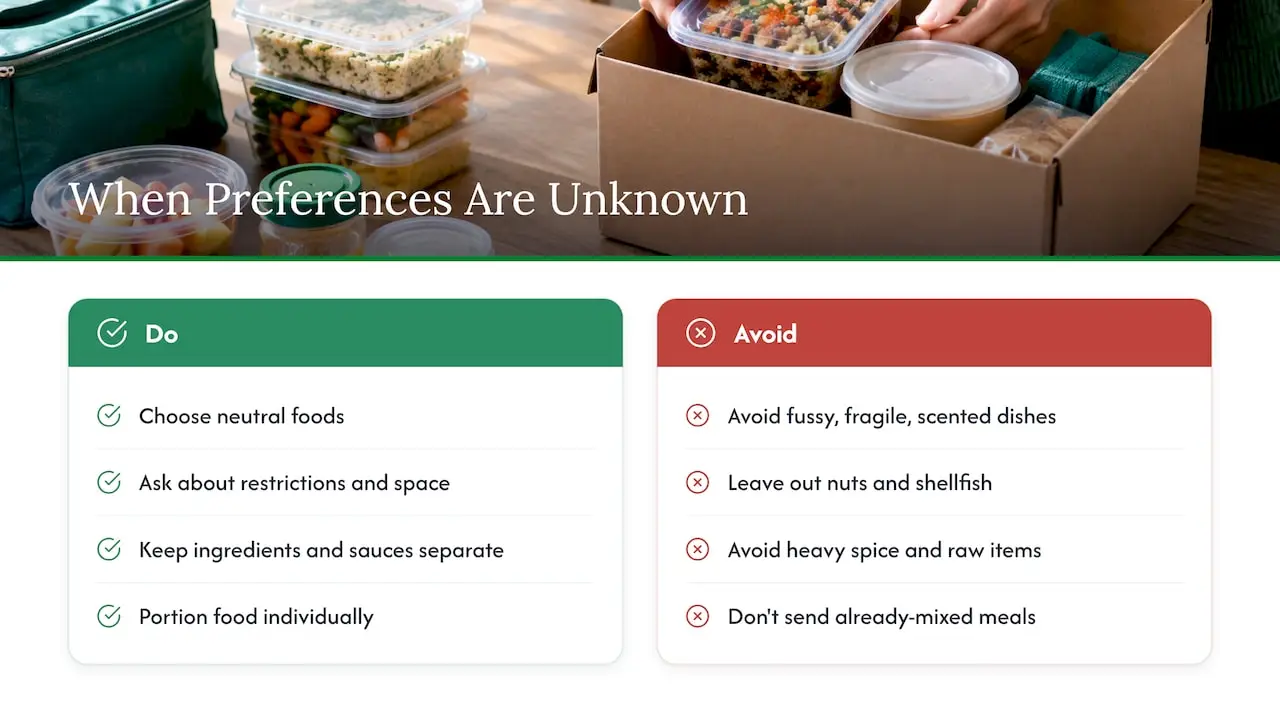
Choose neutral over adventurous. The funeral-industry guide recommends neutral foods such as baked pasta or rotisserie chicken with simple sides, and advises avoiding fussy, fragile or strongly scented dishes. A fragrant fish dish in a small apartment can be hard on someone who is already nauseated with grief.
Ask before you order. Wirecutter’s advice is to ask about food allergies, dietary or religious restrictions, special circumstances and space limits, and to either cook a large batch or portion food individually so people can reheat small amounts. If you cannot reach the family, ask a close friend, a neighbor or a relative. One quick text to the right person saves a wasted gift.
Pick adaptable meals. America’s Test Kitchen suggests keeping ingredients separate and serving sauces and toppings on the side, so each person can build a plate that suits them. Roasted proteins, grains and vegetables packed in separate containers follow the same logic. A dish that arrives already mixed leaves no room to adjust.
Be careful with the usual troublemakers. Nuts, shellfish, heavy spice and raw items are where unknown preferences most often go wrong. If you do not know the household, leave them out or mark them clearly.
Honoring the family’s food traditions
Sometimes the most thoughtful meal is not the safest one. Empathy notes that certain traditional foods tied to a family’s culture and background can be a deeply respectful way to honor the loved one who died. If you know the family’s heritage, a dish from their own table can say what a card cannot.
This applies only when you know. If you are unsure, ask a relative what the person who died loved to eat, or what the family usually serves at gatherings. Offering a dish the person was known for is one of the quieter ways to remember them. If you are looking for other ways to remember someone alongside the meal, these memorial tribute ideas can help you pair a meal with a personal gesture.
In Miami, food heritage is rarely simple. Households often blend Caribbean, Latin American, Middle Eastern and Southern traditions in a single family. That is part of why a one-size-fits-all sympathy basket can feel generic here, and why a short conversation about what the family actually eats pays off.
When to deliver
Timing matters as much as the menu. In the first two days after a death, a household is often flooded with casseroles, platters and baked goods, and much of it goes to waste. The funeral-industry guide notes that families often receive an excess of food in the first 48 hours, and that days 4 to 10, or the second to fourth weeks, can be a more impactful time to provide support.
That is when the visitors leave, the paperwork starts and nobody is cooking. A meal that arrives then tells the family they have not been forgotten.
A few ways to use that timing:
- Send something small right away if you want to be present early, such as a snack box or breakfast items that do not need to be refrigerated.
- Schedule a proper dinner for the following week. Put it on your calendar so it does not slip.
- Plan a third meal weeks later, when the support has thinned out.
- Coordinate with others. A shared calendar or meal-train tool, as Wirecutter notes, helps avoid duplicates and keeps support consistent over time.
How to send a sympathy meal to a home or funeral home
Decide where the food is going before you decide what it is. A family home, a funeral home and a relative’s house each need something different.
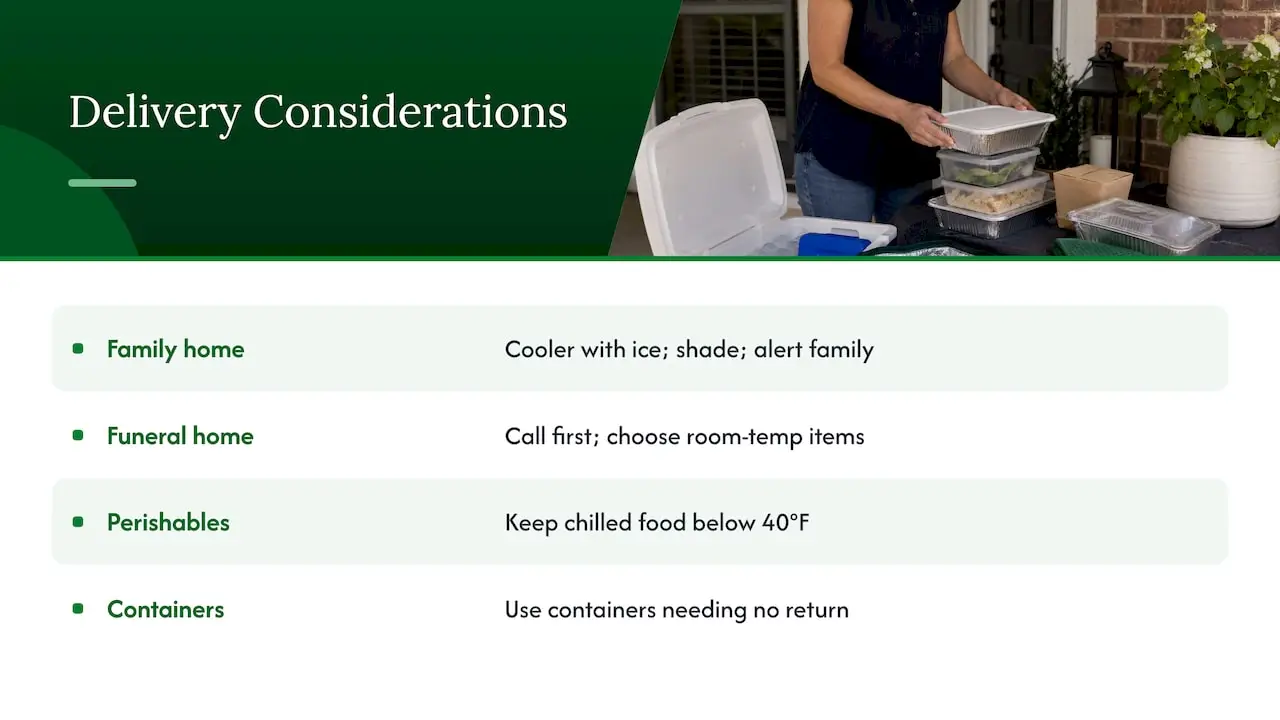
To the family home. Confirm the address, a delivery window and whether anyone will be there. University of Arkansas extension guidance suggests delivering food in a cooler with plenty of ice, placing it in the shade if possible, and alerting the family so they do not have to answer the door right away. In South Florida’s heat, that advice is worth following. A porch is not a refrigerator.
To a funeral home or gathering. Call the funeral home first and ask whether they accept deliveries and whether the family wants food at the service. Choose items that hold well at room temperature: fruit, baked goods, a snack or sandwich platter.
For food safety. If you are arranging shipping or delivery of anything perishable, read our guide to sending a food gift that arrives below 40°F, which explains how chilled food should travel and what to ask a provider.
Skip the return trip. The funeral-industry guide advises using a container the family does not need to return. Disposable or clearly labeled keep-it containers are best.
What to write on the card
Most people overthink the message. Keep it short, warm and practical. You do not need to explain grief or find perfect words. You need to say that you are thinking of them and make the meal easy to accept.
The funeral-industry guide offers an example of a specific, gentle message: “I’m bringing dinner Tuesday. Would 5:30 porch drop-off work, or is later better?” The strength of that note is that it offers a time and gives the family an easy way to adjust, without asking them to come up with a plan.
A few rules that hold up:
- Name the person who died, if you knew them.
- Say what is in the meal and how to reheat it.
- Add “no need to reply” so the family does not feel they owe you a thank-you.
- Leave out advice, silver linings and religious phrasing unless you know it will be welcome.
Sample wording: “We are thinking of you and of Marcus. Dinner is on its way Thursday evening, with portions for four. There is nothing to return and no need to reply. We are here whenever you want us.”
Our perspective on sympathy meals
We cook small-batch meals that are never frozen, and we have learned that a meal for a grieving household is a different job from a regular order. The food has to taste like care, and it also has to be easy to receive. Chef Virginia designs and prepares every menu herself, and clients talk to her directly, which matters most when the order is a sympathy gift. A form cannot capture that a husband is vegetarian, that a daughter has a nut allergy, or that the family would rather have something that tastes like home than something fancy.
Our Haitian-Lebanese heritage shapes how we think about this. In both traditions, food is how a community shows up in hard times: you bring something to the house, and you stay until it is eaten. That belief, that a plate of real food is a form of presence, guides how we approach sympathy orders. We keep the flavors comforting, we portion for the household, and we label what is inside.
Our advice is simple. Ask what the family eats, send something they can have at the table without effort, and think about the week after the funeral as much as the days before it. A meal that arrives when the house is quiet matters more than the third lasagna in a row.
— Virginia Jiha
Sending a meal in Miami with VJ Cuisine
If the family is in Miami-Dade, we can prepare a chef-crafted meal and deliver it to their home. We cook in small batches, never freeze, and can tailor the menu to allergies, dietary needs and the household’s tastes. You tell us who it is for and what you know, and we help you decide what to send.
For a one-time gift, start with our culinary gift delivery in Miami. If you would like to support a family over several weeks, a chef-prepared meal plan can be arranged so dinners keep arriving after the first wave of casseroles has passed. For a gathering after the service, our boutique catering can cover a small group. Pricing is quoted per order, so contact us through the site with the date, address and number of people.
Other ways to help besides a meal
Food is one kind of help. If a meal is not possible, or you want to add to it, consider these:
- Pair the meal with practical items, such as paper plates, napkins and a few drinks, so the family does not need to wash dishes for visiting relatives.
- Offer a second visit, such as breakfast the day after the service for relatives staying in town.
- Send a gift that lasts, such as a thoughtful edible gift the family can keep in the pantry for the weeks ahead.
- Follow up later. A text a month after the funeral that says “I’m bringing dinner Thursday” can mean more than anything sent early on.
If you are also thanking the people who helped during that time, our guide to thank-you food gifts and etiquette covers how to do it well.
Common mistakes to avoid
- Sending something that needs work. Raw ingredients, kits and anything that needs assembly are tasks, not gifts.
- Choosing a statement dish. Strong spices, heavy fish flavors and unusual ingredients carry more risk than comfort.
- Ignoring the family’s diet. Allergies and religious restrictions are not minor details. Ask first.
- Delivering without warning. A doorbell is hard for someone in grief. Text ahead and leave the food in a cooler.
- Sending only once, and only early. Support often fades after the first week.
- Asking for the container back. Use packaging the family can recycle.
FAQ
What is an appropriate sympathy meal gift?
Choose something ready to eat or easy to reheat that needs no shopping, assembly or washing up. Baked pasta, soups, breakfast items and individually portioned meals all work. Mild, familiar flavors are the safest choice, and a meal that fits the family’s own food traditions can be even more meaningful.
How do I send a sympathy meal if I live far away?
Use a delivery provider local to the family, or a chef service that delivers in their area, and ask a relative or friend for the address, a delivery window and any allergies. Send a short note by text so the family expects the delivery. If you are in Miami or sending to Miami-Dade, we can prepare and deliver the meal ourselves.
Should I send food right after the death or wait?
The first two days often bring more food than a household can eat. Many guides suggest days 4 to 10, or weeks two to four, as a time when a meal does more good. If you want to send something early, make it small and shelf-stable.
What should I do if I do not know the family’s dietary needs?
Ask a close relative or friend about allergies and restrictions before you order. If you cannot, choose a neutral dish such as roasted chicken with rice and vegetables, keep sauces on the side and avoid nuts, shellfish and strong spice. Label the ingredients on the container.
Sources
- Bringing Food After a Death: What to Make, When to Deliver, and How to Avoid Overwhelming the Family
- When a Friend Is in Need, Show You Care With Food (Wirecutter)
- Our Top 8 Tips for Taking Food to Grieving Loved Ones (Krause Funeral Home)
- How to Cook for a Crowd with Different Dietary Requirements (America’s Test Kitchen)
- Bringing meals to a bereaved family (Empathy)
- Caring from the Kitchen: Sharing Suppers (University of Arkansas Extension)
- Memorial Tribute Ideas