

Yes, you should plan to tip a private chef, and the customary amount is 15% to 20% of the total cost when no service charge is already built in. Industry guidance puts it in that range, and a tip is a thank-you, not a legal obligation. The right number depends on three things: whether your invoice already includes a service charge, whether the service is a one-time event or a recurring meal plan, and how much custom work the chef did for you.
This guide walks through each of those, with worked dollar examples, so you can decide before the night of your dinner and not at the door with a card reader in your hand.
TL;DR
- Tip 15% to 20% of the food and labor total for a one-time private chef dinner, unless a service charge is already on your invoice.
- Check the agreement first. If a service charge or gratuity is included, an extra tip is optional.
- For complex dietary needs, a custom tasting menu or a last-minute change, 20% or a little more is a fair way to say thank you.
- For recurring weekly meal plans, per-delivery tipping is generally not expected. A holiday bonus, a referral or a strong review is the usual gesture.
- Cash in a sealed envelope handed to the chef is the most direct method. Digital tips are widely accepted too.
Table of Contents
- Do you tip a private chef?
- How much to tip a private chef
- Check the agreement before you decide
- One-time dinners versus recurring meal plans
- How and when to give the tip
- Other ways to say thank you
- Our perspective on tipping at VJ Cuisine
- Booking a chef in Miami
- A quick checklist before the dinner
- FAQ
- Sources
Do you tip a private chef?
Most etiquette sources say yes. A gratuity is the standard way to recognize exceptional labor, and private chefs do a lot of work you do not see: menu design, sourcing, shopping, prep before arrival, cooking in a kitchen that is not their own, and cleanup.
There is a nuance worth knowing. Some professionals build a service fee into their contract, and for an independent chef, a tip is optional. So the honest answer is that tipping is customary and appreciated, rarely required, and sometimes already covered.
A private chef is not a restaurant server. A server’s wage is built around tips. A private chef sets a rate that is meant to cover the work. That is why you will hear some hosts say a tip is unnecessary and others say 20% is the floor. Both are describing the same custom from different angles. Our advice: if the experience met your expectations, tip within the ranges below. If it did not, speak to the chef or company directly rather than using the tip as a message.
How much to tip a private chef
For a single event with no service charge, the common range is 15% to 20% of the total cost. The figure to calculate on is the food and labor total, excluding sales tax.
Here is how that looks on common totals, before sales tax:
| Food and labor total | 15% | 18% | 20% | 25% |
|---|---|---|---|---|
| $300 | $45 | $54 | $60 | $75 |
| $500 | $75 | $90 | $100 | $125 |
| $1,000 | $150 | $180 | $200 | $250 |
| $2,000 | $300 | $360 | $400 | $500 |
What to tip on a $500 private chef meal
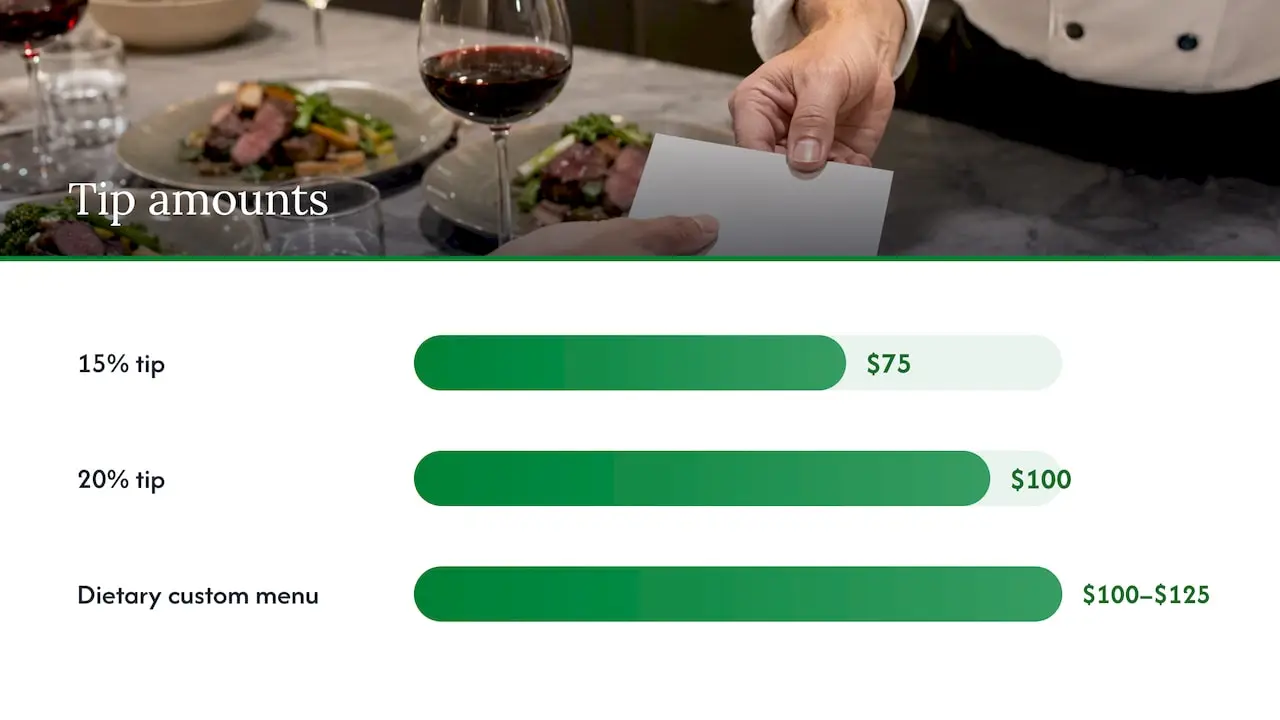
On a $500 meal, 15% is $75 and 20% is $100. Most hosts land between those two. If the chef built a custom menu around a food allergy or a guest’s dietary restrictions, going to $100 to $125 is reasonable. If a service charge is already listed on the invoice, you can stop there or add a small amount in cash for a standout evening.
The same arithmetic applies if you are asking whether you should tip a caterer 20%. For a staffed catering job, 20% is a common ceiling. For a chef who personally cooked and served your table, it sits in the middle of the range.
When a higher tip makes sense
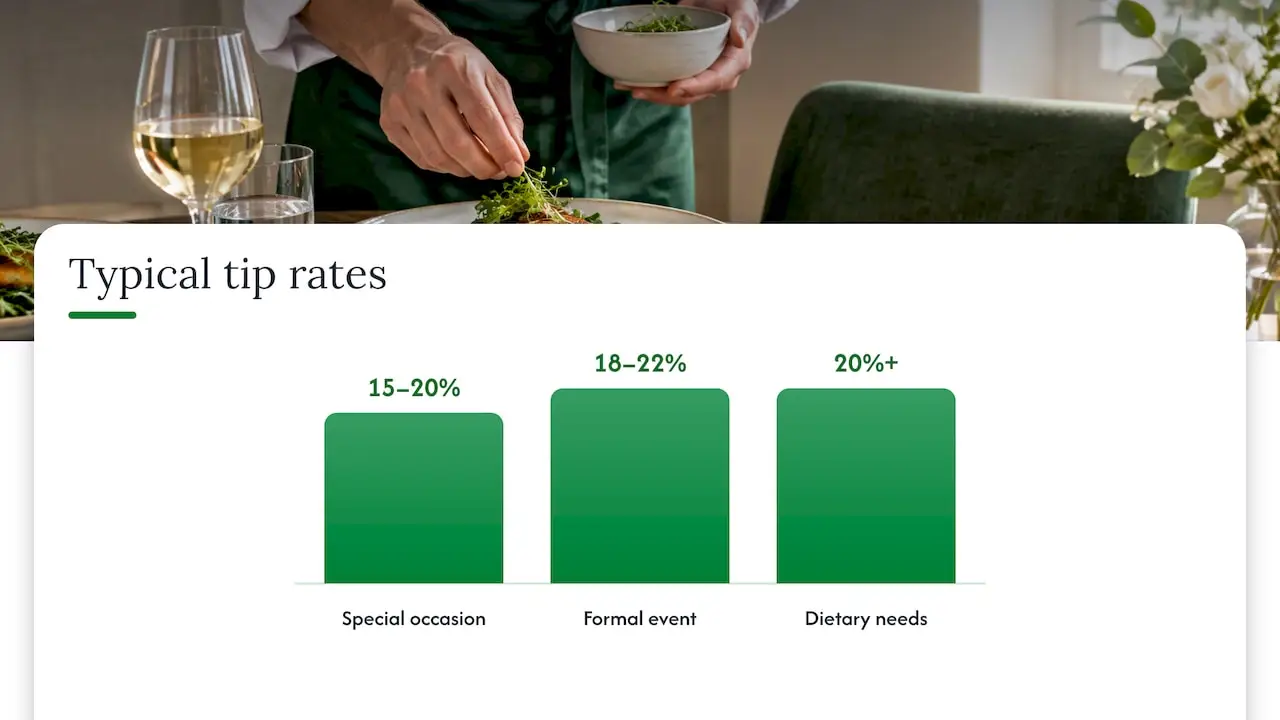
Some situations justify the upper end or beyond. Corporate or formal events typically see 18% to 22%. Other guides suggest 20% to 25% for custom menus, but treat that as a ceiling for exceptional effort, not a baseline.
Consider going higher when:
- The chef handled a complex dietary restriction or a last-minute change.
- The menu was created from scratch for your occasion, such as an anniversary or a multi-course tasting.
- The group was larger than first planned, or the kitchen was difficult to work in.
- The chef stayed late or handled service and cleanup beyond the agreement.
When a lower tip is fine
A smaller tip, or none, is acceptable when the price already includes a service charge, when the chef is the business owner and has told you tipping is not expected, or when your budget is stretched and you plan to show appreciation another way. A specific, enthusiastic review does real work for a small chef business.
Check the agreement before you decide
The most common tipping mistake is paying twice. Before the dinner, read your agreement or invoice for a line called service charge, gratuity, admin fee or labor fee. Clients should confirm whether a service charge or gratuity is already included before adding an extra tip, and if one is, an additional tip is optional.
Three questions to ask the chef or company in writing:
- Is any gratuity or service charge included in the quote?
- If so, does the full amount go to the chef and the staff who worked the event?
- Is sales tax listed separately?
The same habit helps with any hospitality booking. A line like a room rental food minimum, for example, changes what you actually owe, so reading how a minimum or fee is defined before the event keeps the final bill predictable.
Service charge versus tip
These are not the same thing. In the United States, the IRS draws a legal distinction between discretionary tips and mandatory service charges, which affects how payments are reported as wages. For you as the client, the practical takeaway is simple: a mandatory charge on the invoice is part of the price, and a tip is what you add voluntarily on top. If you are unsure which a line item is, ask before paying.
One-time dinners versus recurring meal plans
The etiquette changes with the arrangement.
One-time events. A birthday dinner, an anniversary or a dinner party follows fine-dining norms, with a 15% to 20% gratuity. The chef shops, cooks and often serves in a single evening, so the tip reflects that concentrated effort. For more on what that evening involves, see how a private chef dinner party works in Miami.
Recurring services. Weekly meal plans work more like a professional retainer. In that case, per-session tipping is generally not expected, and appreciation is shown through annual bonuses or periodic gifts instead. A common pattern is a holiday bonus. A reasonable benchmark many clients use is the cost of one week of service, though that is a custom rather than a rule, so scale it to your own budget and relationship.
Delivered meals. If a chef cooks in their own kitchen and delivers to your door, there is no on-site service, so the tip expectation is lighter. A round-up, a modest percentage on a large order, or a holiday gratuity is plenty.
| Situation | What is typical |
|---|---|
| In-home dinner for a special occasion | 15% to 20% of food and labor total |
| Corporate or formal event | 18% to 22% |
| Custom menu with complex dietary needs | 20% or slightly more |
| Weekly meal plan | No per-delivery tip; holiday bonus or gift |
| Service charge already on invoice | Tip optional |
How and when to give the tip
Timing is simple: at the end of the service, once the chef has finished and before they leave. Cash in a sealed envelope handed directly to the chef is the most direct and accepted method. Adding a tip to the invoice also works, provided you know the full amount reaches the chef and any staff.
A few practical points:
- Prepare ahead. Put the cash in an envelope before guests arrive, so it is not awkward in front of the table.
- Ask about digital tips. Many private chefs accept card or digital tips, so ask when you book if you prefer not to carry cash.
- Tip the team. If a chef brought a server or assistant, ask whether to tip the chef who splits it, or hand the chef a separate envelope marked for staff.
- Write a note. A line about what you loved, such as the dish your guests kept talking about, often means as much as the amount.
Other ways to say thank you
Money is not the only currency. Five-star public reviews, referrals and sincere testimonials are highly valued by independent chefs because they bring in the next booking. If your budget is tight, or you are a regular client, these are meaningful and cost nothing.
If you would like to thank a chef with something tangible, a handwritten note, a rebooking for a friend’s event, or a small gift all land well. If you are on the other side and want to send food as thanks to someone in your own life, our guide to chef-curated thank-you food gifts covers etiquette and shipping rules.
Our perspective on tipping at VJ Cuisine
We cook small-batch, never-frozen meals, and Chef Virginia designs and prepares every menu personally. Because clients talk to the chef directly, we see tipping questions come up before the event more often than after it, and we think that is the right order. Clients feel more comfortable when they know what the price covers, what is optional and how to show appreciation.
Our view is that a tip should follow the work. A custom menu built around a guest’s allergy, a family that needs several dietary needs handled at one table, or a request that changes the week before the dinner is real extra effort. A routine weekly delivery is a different thing, and we would never want a client to feel pressured to tip on every drop-off.
What we do ask is that clients treat us like a professional relationship. Tell us your budget, ask about gratuity when you book, and let us know afterward what worked. Honest feedback and a kind review do more for a small kitchen than a number on a receipt.
— Virginia Jiha
Booking a chef in Miami
If you are planning an evening at home, our private dinners are cooked in your kitchen with a menu shaped around your guests and any dietary needs. For ongoing weeknight meals, our healthy meal plans are fresh, small-batch and delivered across Miami. Tell us about your occasion and ask about gratuity when you book, so there are no surprises on the night.

If you are still comparing options, our guide to hiring a private chef in Miami covers pricing ranges and vetting checks, and the piece on planning a tasting menu at home shows how a multi-course evening is paced.
A quick checklist before the dinner
- Read the quote for any service charge, gratuity or labor fee.
- Ask whether tips are shared with staff.
- Decide your percentage on the pre-tax food and labor total.
- Prepare a sealed envelope or confirm a digital tipping option.
- Note any dietary complexity or changes you requested, since they justify the higher end of the range.
- Plan a review or referral as a follow-up.
FAQ
Are you supposed to tip private chefs?
Tipping is customary but usually not required. A gratuity is the standard way to recognize the chef’s work, and for independent chefs it is optional. If your invoice already includes a service charge, you are not expected to add more.
What is the standard tip for a private chef dinner?
For a one-time dinner without a service charge, 15% to 20% of the food and labor total, before sales tax, is the common range. Corporate or formal events can run 18% to 22%. Go toward the top for custom menus or complex dietary needs.
Do you tip a private chef on a weekly meal plan?
Generally not per delivery. Recurring service is treated like a professional retainer, so appreciation usually comes as a holiday bonus, a gift, a referral or a positive review.
Should I tip in cash or on the invoice?
Cash in a sealed envelope handed to the chef is the most direct method. A tip added to the invoice works if you confirm the full amount reaches the chef and staff. Many chefs also accept card or digital tips, so ask when you book.
Do you tip on the total with sales tax?
No. Calculate on the food and labor cost, excluding sales tax. On a $500 meal before tax, 15% to 20% is $75 to $100.
Sources
- Do You Tip a Private Chef? (Chef’s Resource)
- Do you tip a private chef? (Tip a Chef)
- Do You Tip a Personal Chef? When and How Much to Tip (Climb the Ladder)
- Fact Sheet: How to Report Tips and Service Charges (Tax Notes)
- What a Room Rental Food Minimum Really Means for Your Event