
Plated service brings each guest an individual, composed dish, so it feels formal and controlled. Family style puts shared platters on the table, so it feels generous, social and relaxed. Choose plated when precision, a tight timeline and a formal tone matter most. Choose family style when conversation, variety and a warm atmosphere matter more. Both can be elegant. What separates them is how guests experience the meal, how the kitchen and servers work, and what each does to your budget and schedule.
TL;DR
- Plated: each guest gets an individually served dish. It suits formal events, strict timelines and guests who want a predictable portion.
- Family style: shared platters are passed or placed at each table. It suits celebrations built around conversation, variety and a generous feel.
- Cost: one 2026 industry guide puts plated at roughly $75 to $150 per head and family style at $65 to $120. Your quote depends on menu, staffing and rentals.
- Dietary needs: plated makes individual dishes easy to label and deliver. Family style needs clear platter labeling and serving utensils for each dish.
- Decision shortcut: match the service to the mood you want, then confirm the logistics with your caterer.
Table of Contents
- What each service style actually means
- Family style vs. plated at a glance
- Atmosphere: formal polish or shared generosity
- Cost: what the numbers say, and what moves them
- Timing and pacing
- Guest experience and dietary needs
- Space and setup
- How to choose: a short decision guide
- What about a buffet at a formal event?
- Red flags when you are choosing a caterer
- Our perspective
- Plan your Miami event with VJ Cuisine
- Related reading for hosts
- FAQ
- Sources
What each service style actually means
The two terms get mixed up, partly because in both cases guests stay seated and food comes to them.
Plated service (also called a seated or sit-down dinner) means the kitchen builds each plate, and servers deliver them to guests, usually course by course. Guests often choose an entree in advance, or a single entree is served to everyone.
Family style means food arrives in large dishes and guests serve themselves at the table. The Cambridge Dictionary describes the term as mainly American and defines it as food brought to the table in large dishes so people can help themselves. That is the heart of it: the platter belongs to the table, not to one person.
A third option, the buffet, sends guests to a station to build their own plates. Family style keeps the shared-platter idea but removes the line, because the food comes to the guests.
Family style vs. plated at a glance
| Factor | Plated | Family style |
|---|---|---|
| Atmosphere | Formal, polished, ceremonial | Warm, social, generous |
| Guest choice | Choice made ahead or one set entree | Guests take what and how much they like |
| Portion control | Fixed per guest | Guests decide; the kitchen plans for abundance |
| Pacing | Predictable, course by course | Flexible, set by the table |
| Conversation | Guests talk mainly with neighbors | Passing dishes gets the whole table talking |
| Table space | Needs less room for food | Needs room for platters and serving utensils |
| Dietary handling | Individual plates can be labeled and delivered | Needs separate, labeled platters and utensils |
| Typical cost | Often higher, with more labor | Often lower per head, with more food volume |
Atmosphere: formal polish or shared generosity
Plated dinners signal occasion. Every plate arrives at once, the presentation is controlled, and the kitchen decides how each dish looks. That is why plated service is a classic choice for weddings with a formal dress code, milestone anniversaries and corporate dinners where hosts give a toast between courses.
Family style signals hospitality. Guests reach, pass and compare, and the table becomes part of the entertainment. It tends to work well for rehearsal dinners, birthdays, engagement parties, holiday gatherings and any event where you want people who barely know each other to start talking. If your event is in a private home, family style also fits the setting naturally.

There is an emotional side to this too. Many families already eat this way. The New York Times has reported that serving family-style dishes lets everyone help themselves from the food on the table, and that it can ease the tension around what is for dinner. A dietitian quoted in that piece calls the approach “exposure without pressure” for children. For a party with kids at the table, that is a real advantage: they see the food, choose at their own pace and do not face a plate they did not pick.
Cost: what the numbers say, and what moves them
Budget is the first filter for most hosts, but the answer is less obvious than it looks. According to a 2026 comparison from a wedding stationery company, plated catering runs about $75 to $150 per head, and family-style catering about $65 to $120 per head. Family style usually lands lower at the same quality level, but the ranges overlap, so a premium family-style menu can cost more than a modest plated one.
What drives the difference:
- Labor. Plated service needs enough servers to deliver and clear every plate at the same moment. Family style needs fewer hands at the table, but someone must refill and reset platters.
- Food volume. Shared platters have to look and feel abundant, so the kitchen prepares more than a fixed plated portion would use. Our catering portions per person guide walks through how to size a menu so you are neither short nor wasteful.
- Rentals. Family style calls for platters, serving spoons and sometimes larger tables. Plated calls for more flatware and plates for each course.
- Menu complexity. A three-course plated meal with a choice of entree is more complex than two entrees shared at a table.
One more point: a quote that leaves out service charges, rentals or overtime can bring surprise costs later. Whichever style you pick, ask for an itemized proposal so you can compare the two honestly.
Timing and pacing
Plated service is the easier style to put on a clock. Courses come out on a schedule, toasts slot between them, and the room moves together. If your event has a hard end time, a program with speeches, or a venue with a strict curfew, plated gives you the most control.
Family style runs on the table’s rhythm. Platters arrive, guests serve themselves, and a table of eight may finish a few minutes before or after the next. The pace feels more relaxed, which is the point, but it needs a plan. Ask your caterer when platters will be refreshed, and schedule speeches for after the main course is served rather than during it.
Music helps set the pace in either case. A planner who wants a formal feel without a rigid structure can lean on live dinner reception piano to shape the atmosphere through the meal, so guests settle in and conversation carries the evening.
Guest experience and dietary needs
This is where the two styles differ most in practice.
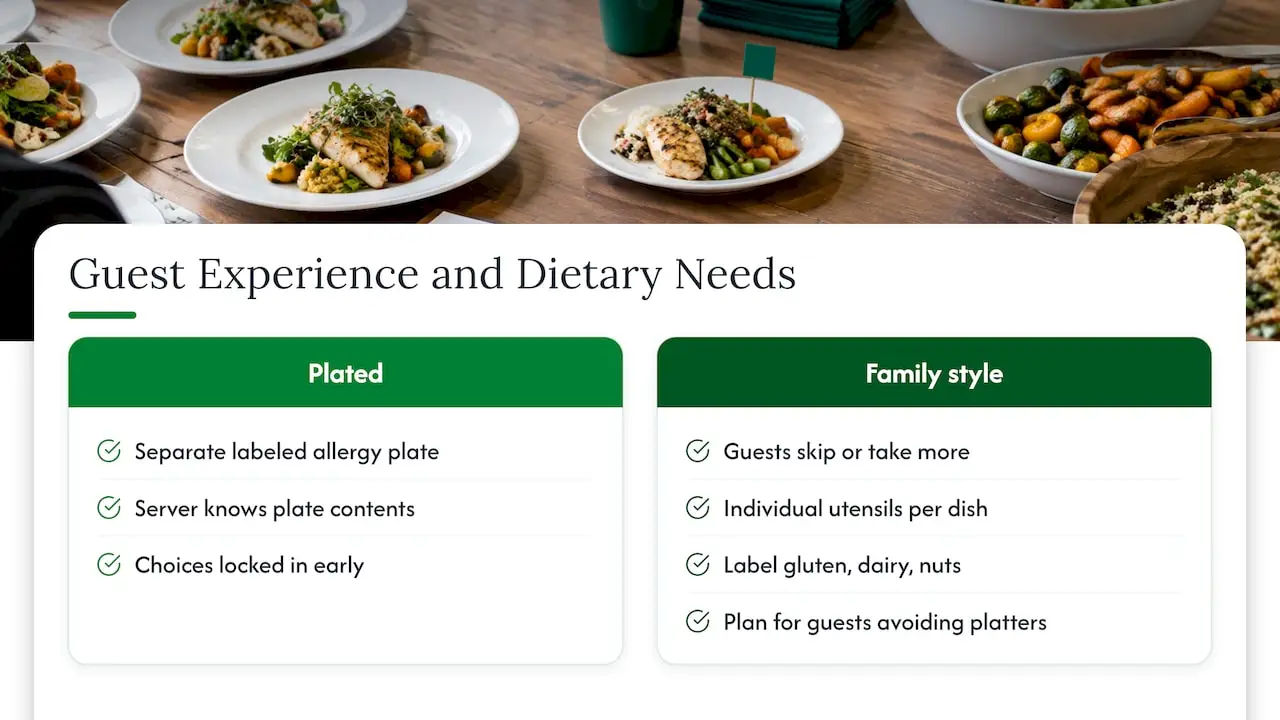
Plated: A guest with a food allergy or dietary restriction can receive a separate plate prepared for them. It can be labeled and delivered by a server who knows what it contains. The tradeoff is that choices are locked in early, and a guest who changes their mind has little room to adjust.
Family style: Guests can skip what they do not eat and take more of what they love. That flexibility is helpful for picky eaters, vegetarians and anyone managing portions. For allergies, the details matter. Dishes need individual serving utensils, clear labels for ingredients such as gluten, dairy and nuts, and a plan for guests who should not share platters. If gluten is your main concern, our guide to Miami catering with gluten-free options explains cross-contact and what to ask about before you book.
A reasonable approach in both styles is to collect dietary needs with your RSVPs and give them to the caterer well in advance. A caterer with no plan for dietary needs at scale is another of the common red flags to watch for when you are hiring.
A small hygiene note for family style and buffet-adjacent service: serving spoons should stay in their dishes and not touch guests’ plates. Food-safety coverage notes that reusing a plate for seconds can cause cross-contamination when serving spoons touch it. At a family-style table, the easy fix is a dedicated utensil in each dish and a clean plate when guests want a different course.
Space and setup
Table space is a practical question that hosts often discover late. Family style puts several large dishes on each table, plus plates, glasses and centerpieces. A round table of eight may need room for three or four platters. If the room is tight, you may need to choose smaller platters, two smaller dishes in place of one large one, or a lower centerpiece.
Plated service needs less table surface but more service routes. Servers must reach every seat, and rooms with narrow gaps between tables slow down delivery. In a home setting, plated can be harder than it looks because a home kitchen has to plate many dishes at once. That is one reason private in-home dinners often work best with a chef who is on site and manages the plating and pacing personally.
How to choose: a short decision guide
Work through these questions in order.
- What mood do you want? Formal and ceremonial points to plated. Warm and conversational points to family style.
- How tight is your timeline? A strict schedule favors plated. A flexible evening suits family style.
- Who is coming? Large groups of strangers, older relatives or many kids can change the answer. Mixed-age groups often enjoy the self-serve ease of family style.
- What are the dietary needs? Several serious allergies may favor plated for individual control. Many different preferences without serious allergies may favor family style.
- What is your budget? Request itemized quotes for both. The per-head figures overlap, so compare the full proposal.
- How much room do you have? A small space may limit family style. A narrow room may limit plated service.
If you land on a tie, a hybrid is common: a plated first course or salad, followed by family-style mains and sides, and dessert plated or passed. You get an orderly start, a generous middle and an easy finish.
What about a buffet at a formal event?
It is a fair question, and it appears often in search. A buffet can be elegant when it is staffed, well designed and paced properly, with food that holds well and clear stations. Family style often answers the same need with less standing in line, because the food comes to the guests. If your guest list is large and your budget is moderate, both are worth pricing.
Red flags when you are choosing a caterer
Whichever style you choose, the caterer matters more than the format. Watch for:
- no tasting before you commit, or vague menu terms in the contract
- unclear staffing ratios, which matter more for plated service
- no plan for dietary needs
- quotes missing service charges, rentals or overtime
- no recent references
These are drawn from a 2026 list of caterer red flags. Ask for a tasting, ask how dishes will be labeled, and ask who will be on site to run service.
Our perspective
For us, the question is less about which style is better and more about what the evening should feel like. Every menu we make is designed and prepared by hand, in small batches and never frozen, and that shapes how we think about service.
Family style suits our cooking well. Haitian-Lebanese food is built for sharing: bright herbs, slow-cooked dishes, and spreads of mezze-style plates and mains that look best when they sit in the center of the table. When guests pass platters, the food does part of the hosting.
Plated service is the right call when the occasion needs a composed, course-by-course rhythm. A tasting-style dinner is a good example, and we have written about how to plan, pace and serve a tasting menu at home.
Because you speak directly with the chef, you do not have to pick from a fixed format. Tell us the guest count, the mood and any dietary needs, and we will recommend the style, the portions and the pacing that fit your event.
Virginia Jiha
Plan your Miami event with VJ Cuisine
If you are weighing family style against plated for a gathering in Miami, we can help you decide and then cook it. VJ Cuisine offers boutique catering for events and private in-home dinners, with fresh, small-batch, chef-crafted menus tailored to dietary needs.
For larger gatherings, see our custom catering in Miami. For an intimate evening at home, look at our private dinners. Prices are quoted for your specific menu and guest count, so tell us what you have in mind and we will build the proposal around it.
Related reading for hosts
If you are deciding how to structure a menu, two of our other guides can help. Our comparison of prix fixe and à la carte service covers cost and pace in a similar way. For a relaxed gathering at home, our housewarming catering ideas show how to serve safely and portion well.
FAQ
What is meant by family style?
Family style means food is brought to the table in large shared dishes, and everyone serves themselves. The Cambridge Dictionary calls it a mainly US term. At an event, servers usually bring the platters to each table, so guests do not leave their seats.
Is family style cheaper than plated?
Often, but not always. One 2026 industry guide lists plated at $75 to $150 per head and family style at $65 to $120. Since those ranges overlap, ask for an itemized quote for both styles, including staffing and rentals.
Which is better for guests with allergies?
Plated service makes it easy to prepare and deliver a separate, labeled plate. Family style can work well too if dishes are labeled and each has its own serving utensil. Share every dietary need with your caterer well before the event, and ask how they will prevent cross-contact.
Can I combine family style and plated service?
Yes. A common approach is a plated first course, family-style mains and sides, and a plated or passed dessert. It gives you structure at the start and a generous, social middle. Talk through the timing with your caterer so servers and kitchen are aligned.
Sources
- FAMILY-STYLE | English meaning, Cambridge Dictionary
- Anxious About Family Mealtimes? Serve a Buffet, The New York Times
- Plated vs Buffet Wedding Reception: Cost, Timing, and Guest Experience, Paperlust
- 9 Wedding Caterer Red Flags to Watch Before You Sign, Gorgeautiful
- Why It’s A Big Buffet Mistake To Use The Same Plate For Seconds, The Takeout
- Dinner Reception Piano setlists