
Sustainable event catering comes down to a handful of decisions you can specify before you book: a plant-forward menu, ingredients that are fresh and sourced with care, reusable serviceware, portions sized to your real guest count, and a plan for leftovers and waste. A caterer who is serious about these can document them. One who only says “eco-friendly” on a website may not. This guide shows you what to ask for, how to judge the answers, and how it plays out for events in Miami.
TL;DR
- Sustainable catering is a set of specifications, not a label. Ask about menu, sourcing, serviceware, portions, waste sorting and leftovers, and get the answers in writing.
- The biggest levers are usually a plant-forward menu, accurate headcounts and reusable serviceware. Compostable items are a fallback when reusables are not feasible.
- Caterers generally prepare 10% to 15% more food than an event needs, so plan for leftover donation before the day, not during cleanup.
- Small-batch, made-to-order cooking from a chef you can talk to directly makes it easier to control portions and waste at a home dinner or small event.
Table of Contents
- What “sustainable” should mean on a catering order
- Start with the menu
- Portions, headcount and the waste you never see
- Serviceware: reusable first, compostable second
- Questions to ask any caterer before you book
- Our perspective: sustainability starts in the kitchen
- Sustainable dinner parties and home events
- Eco-friendly meal delivery for everyday meals
- Planning your event with VJ Cuisine
- FAQ
- Sources
What “sustainable” should mean on a catering order
The word gets stretched. A menu can be “local” and still be served on single-use plastic. A caterer can offer compostable plates and still throw away a third of the food. A useful definition covers the whole event: what is on the plate, what the plate is, how much food is made, and where the leftovers and scraps go.
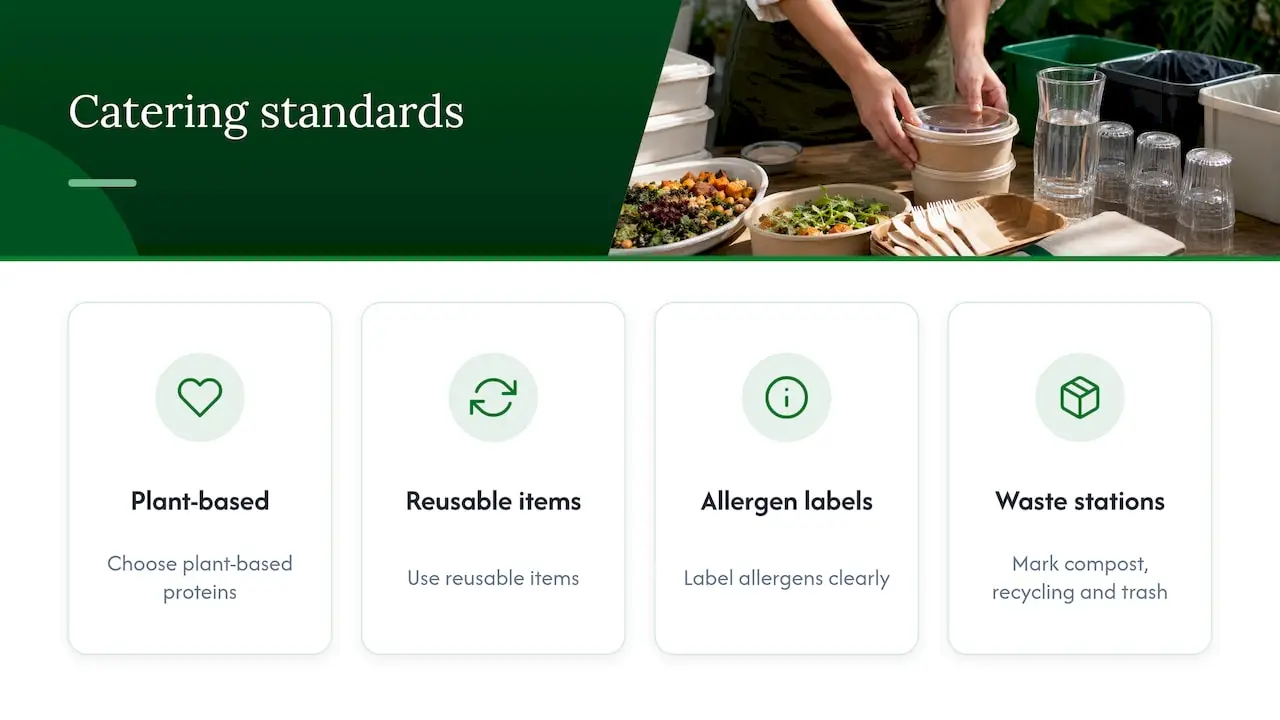
Harvard’s event guidance takes this broad view. It pairs plant-based proteins, reusable items, allergen labeling and clearly marked compost, recycling and trash stations rather than treating any single claim, such as “organic”, as enough. That is a good model for a private party, a corporate lunch or a wedding alike.
Stanford’s Office of Sustainability makes a related point: every choice from the menu to the materials shapes the impact of your event. Its practical standard is to choose a caterer who is willing to document sourcing, serviceware and waste practices, instead of assuming a green description proves anything.
Start with the menu
Food is the largest decision, and it is also the one that guests notice most. Three habits make the biggest difference.
Make plants the center, not the side
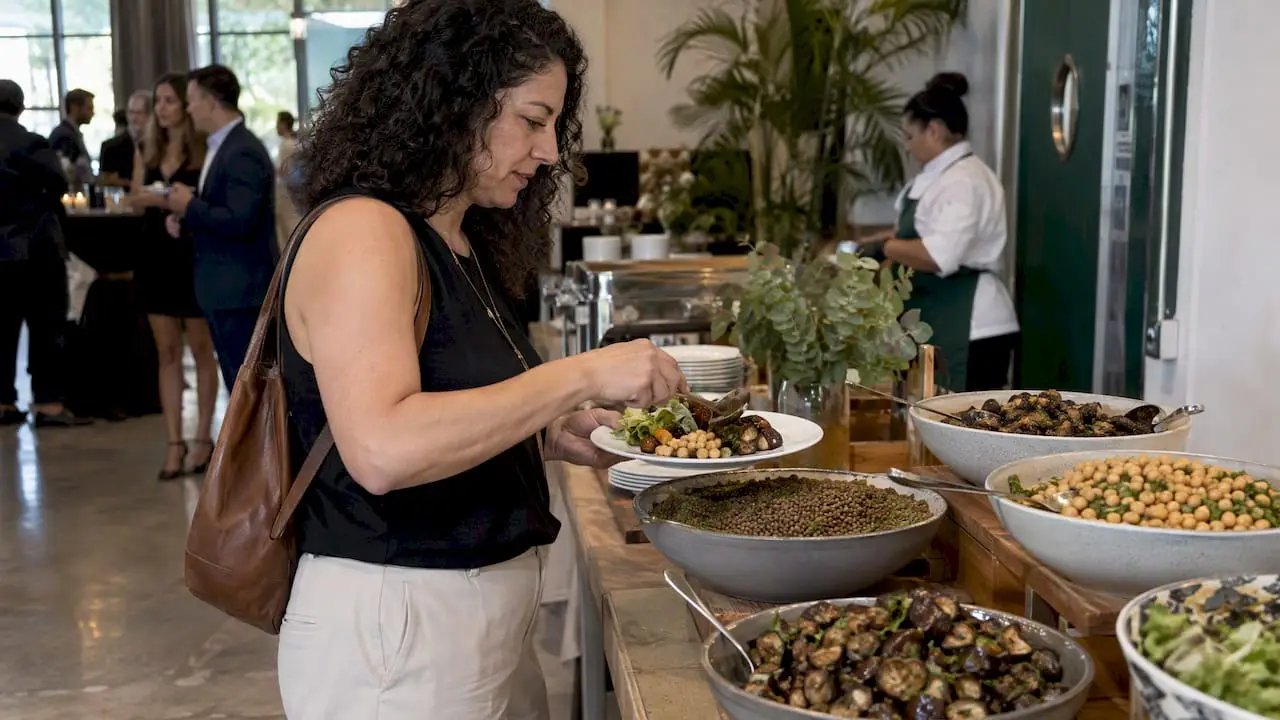
Harvard recommends making plant-based proteins such as beans, lentils or tofu the default or featured main. Stanford likewise lists plant-forward food first among its priorities. This does not mean a single sad plate of steamed vegetables for the one guest who asked. It means a menu where the vegetable and legume dishes are the ones people go back to.
This is where regional cooking helps. Haitian and Lebanese cuisines both lean on legumes, grains, herbs, roasted vegetables and bright, layered seasoning. Dishes built on lentils, chickpeas, eggplant, plantains, rice and fresh herbs are plant-forward by tradition, not by compromise. If you are planning a Miami event, a menu rooted in those traditions gives you full-flavored plant dishes without leaning on meat substitutes.
Choose seasonal and fresh over flown-in and frozen
World Athletics’ guidance for event organizers lists seasonal produce, correct portions and plant-based options among the requirements to write into a catering request. In South Florida, that means asking what is actually in season locally when your event falls, and letting the chef build around it. Our own guide to farm-to-table dining and how private chefs recreate it goes deeper on that approach.
Plan for dietary needs on purpose
Allergen labeling appears in Harvard’s recommendations for a reason: guests who cannot eat what is served often leave a plate untouched, and untouched food is waste. Naming common allergens up front also helps guests choose what they will actually eat. If gluten is a concern for anyone on your list, see our guide to Miami catering with gluten-free options for how cross-contact is managed.
Portions, headcount and the waste you never see
The most sustainable meal is the one that is not over-produced. The EPA-hosted case study on food recovery notes that caterers generally prepare 10% to 15% more food than an event needs. Some of that buffer is sensible. A lot of it is habit.
The EPA’s food-waste prevention material makes the same case from the operations side: source reduction and tracking save money and waste, and are more effective than relying only on composting after excess food has already been made. For a host, that translates to a few simple moves:
- Lock your headcount late, and be honest about it. Ask your caterer for their final-count deadline and send RSVPs early enough to meet it.
- Match portions to the format. A seated three-course dinner needs different quantities than a cocktail reception with passed bites.
- Ask how the kitchen sizes batches. Small-batch cooking lets a chef adjust quantities closer to the event day.
- Track what comes back. Ask for a simple note of what was left over, so next year’s event is more accurate.
Decide what happens to leftovers before the event
The same EPA case study recommends including leftover-donation language in catering contracts. Do it in advance and it takes one sentence. Do it at 10 p.m. when the party ends and it usually does not happen.
Florida is one of the states with a Good Samaritan food donation law; a Florida Senate bill analysis describes it and notes that all 50 states have adopted some form of such law. That analysis dates from 2008, so confirm current rules with a local food bank or recovery organization before you rely on it. Food safety also matters: only safe, properly held, edible food should be donated, and your caterer and the receiving organization should agree on handling in advance.
Serviceware: reusable first, compostable second
This is where well-meaning hosts most often go wrong. Stanford’s guidance is clear on the order of preference: reusable serviceware first, with certified compostable items only when reusables are not feasible. Harvard also recommends reusable items where possible and pitchers or filtered tap water rather than single-serve beverages.
The reason compostable is second place is practical. A compostable fork in a regular trash bin does nothing useful. It only works if it reaches a composting stream. So if you do choose compostable items, confirm where they will go.
| Choice | When it works well | What to confirm |
|---|---|---|
| Real plates, glassware and cloth napkins | Seated dinners, home events, most private venues | Who washes and returns them, and whether rental or the caterer supplies them |
| Reusable platters and serving pieces | Buffets, family-style service | Whether the caterer brings and collects them |
| Certified compostable items | Large outdoor events, venues without dish facilities | That a composting pickup or drop-off exists for the event |
| Pitchers and water stations | Almost every event | Ice and cup plan so guests do not default to bottles |
Make waste sorting obvious
Harvard recommends clearly identified compost, recycling and trash stations so guests can participate correctly. Signs with photos work better than text. In Miami-Dade, commercial composting services do exist; for example, Fertile Earth says it collects food waste from restaurants, hotels, venues and other generators across Miami-Dade and South Florida. If your venue is a hotel, restaurant or event space, ask whether it already has a composting contract. If it does, your caterer can plug into it.
Questions to ask any caterer before you book
MIT’s Sustainable Catering Checklist is built to evaluate a caterer’s actual practices and is useful for comparing vendors before you request a proposal. You do not need a university procurement office to use the same logic. Bring these questions to your first call:
- Menu: Which dishes are plant-based or plant-forward? Can the featured main be vegetarian?
- Sourcing: What is local or seasonal at the time of my event? Which ingredients are fresh, and which are frozen or pre-made?
- Serviceware: What do you supply reusable? If disposables are needed, what are they made of and where do they go afterward?
- Portions: How do you set quantities, and when is my final count due?
- Leftovers: What happens to edible food that is not served? Will you put donation or take-home packaging in the contract?
- Waste: Who handles sorting and removal at the event, and what does the venue allow?
- Dietary needs: How are allergens labeled and kept separate?
Hold the answers to the same standard as the price. World Athletics advises writing sustainability requirements into the catering request or contract, because requirements become more reliable when they are specific and measurable. A line such as “reusable plates and flatware for all seated courses” is easier to honor than “eco-friendly event.”
Our perspective: sustainability starts in the kitchen
We cook for Miami families, professionals and hosts, and what we have learned is that sustainability is mostly a kitchen habit, not a packaging decision. Everything we make is small-batch, fresh and never frozen, and I design and prepare the menus myself. That matters for waste, because when one chef plans the menu, the quantities and the cooking, there is far less guesswork between what a client asks for and what ends up on the table.
Direct conversation is the other half. Clients talk to me about their guest count, their dietary needs and their preferences, and I adjust. Fewer surprises means fewer surplus trays. It also means that when someone is gluten-free, diabetic or avoiding certain foods, the menu is built around that person from the start instead of patched at the end.
Our Haitian-Lebanese heritage helps too. Both traditions cook with legumes, grains, vegetables, herbs and spices in a way that makes plant-forward dishes satisfying and celebratory. I would rather hand a guest a dish they ask to take the recipe for than a lecture about sustainability.
My honest advice to any host: do not chase a perfect score. Pick the three changes that fit your event, such as a plant-forward main, an accurate headcount and real plates, and get them in writing. Then ask your caterer how they will make them happen.
— Virginia Jiha
Sustainable dinner parties and home events
Everything above scales down to a dinner at home. FoodPrint’s guide to hosting a sustainable dinner party covers low-waste entertaining and climate-conscious menus, and its themes match what we see work in practice: a smaller number of well-planned dishes, real tableware, and leftovers sent home with guests in containers they can reuse.
For a home dinner, here is a simple checklist:
- Build the menu around one or two plant-forward dishes you would be proud to serve alone.
- Confirm dietary needs when you invite, not when you serve.
- Use real plates, glasses and cloth napkins.
- Offer water in pitchers, and keep the drink list short.
- Decide in advance who takes home what is left.
If you would rather not cook for your own party, a private chef can handle the planning, cooking and portioning in your kitchen. Our guide to finding a catering chef in Miami for private events explains what to look for, and for a milestone celebration, see how we approach birthday party catering in Miami.
Eco-friendly meal delivery for everyday meals
Sustainability is not only for events. If you are looking at eco-friendly meal delivery for a busy week, the same questions apply: how fresh is the food, how many ingredients are wasted, and how many single-use containers arrive at your door?
Fresh, made-in-small-batches meals that are never frozen reduce the need for bulk production and long storage. A weekly plan sized to your household also reduces what gets thrown out of your refrigerator. If you have specific health needs, our plans can be shaped around them; see our articles on anti-inflammatory meal plans, diabetic-friendly meal plans and pescatarian versus vegetarian eating for examples. Athletes can look at meal plans with weight-adjusted macros.
Planning your event with VJ Cuisine
We offer boutique catering for events, private in-home dinners, chef-crafted meal plans and handcrafted culinary gifts across Miami. If you want a menu that is plant-forward, fresh and sized to your guest list, start with our catering page for events or our private dinners page for an evening at home. Tell us your date, headcount, dietary needs and any sustainability requirements, and we will build the menu with you. Planning a holiday gathering? See our Christmas catering menus.
We do not publish prices, because each menu depends on the guest count, format and dietary needs, so the best step is to contact us with the details of your event.
FAQ
What makes catering sustainable?
It is a combination of choices: plant-forward menus, seasonal and carefully sourced ingredients, reusable serviceware, portions matched to the real guest count, and a plan for leftovers and waste. No single claim covers all of this. The most credible approach is to ask the caterer to document each one, as Stanford’s guidance suggests.
Are compostable plates better than reusable ones?
Usually not. Stanford’s guidance puts reusables first and recommends certified compostable items only when reusables are not feasible. Compostable items only help if they actually reach a composting stream, so confirm that before you choose them.
How do I reduce food waste at a catered event?
Give your caterer an accurate final headcount, match portion sizes to the style of service, and agree on what happens to leftovers before the event. Caterers generally prepare 10% to 15% more food than needed, so a donation or take-home plan in the contract is worth including. Check local food-safety rules and the receiving organization’s requirements first.
Does sustainable catering cost more?
It depends on the event, and we cannot give a general figure. Some choices, like plant-forward menus and tighter portions, can reduce food quantities, while rented real tableware adds a line item. The clearest way to compare is to ask each caterer for a proposal with the same sustainability requirements written in.
Can a private chef make a dinner party more sustainable?
Often, yes. A chef who plans, shops for and cooks the menu in small batches can size quantities closely to your guest list and build around dietary needs from the start. Ask about sourcing, serviceware and leftovers in the same way you would with any caterer.
Sources
- Sustainable Catering Guide, Sustainable Stanford
- Sustainable Catering Checklist, MIT Sustainability
- Sustainable Meetings and Events, Harvard Office for Sustainability
- Food Management, World Athletics
- Rock and Wrap It Up! Helps Fight Hunger, US EPA
- Preventing Food Waste with Source Reduction, US EPA
- Bill Analysis on Food Donation, Florida Senate
- Commercial Composting in Miami, Fertile Earth
- How to host a sustainable dinner party, FoodPrint