
For most private dinners at home, an informal setting is the right choice: a dinner plate, a fork on the left, a knife and spoon on the right, a glass above the knife and a napkin under the fork or on the plate. Add a salad fork, soup spoon or bread plate only when the menu needs them. If you are serving from platters, give the center of the table to the food first and decorate around it. The rest of this guide covers the layouts, the measurements and the small decisions that make a table feel planned instead of improvised.
We are a Miami private chef service, so we see the table as the other half of the menu. The best setting is the one that fits what is being served, how many people sit down and how the food reaches them.
TL;DR
- Choose the setting by the occasion: informal for family dinners and dates, formal for holiday meals and fancy dinner parties.
- Set only the utensils the menu uses, in the order the courses arrive, working from the outside in.
- Plan roughly 24 to 30 inches of table edge per guest, and keep the center clear if you serve family style.
- For a table of two, pull both settings together at one end and keep candles below eye level.
- Decide the serving style before you set the table, because platters need space that plates do not.
Table of Contents
- Which table setting suits a private dinner?
- How to set an informal dinner table, step by step
- How a formal table differs
- Spacing: how much table does each guest need?
- Family-style table setup
- Family style or plated: choose before you set the table
- A romantic table for two
- Small touches for small groups
- The day-of sequence
- Let the chef handle the menu, so you can focus on the table
- Our perspective
- FAQ
- Sources
Which table setting suits a private dinner?
There are five classic settings: basic, informal, formal, five-course and buffet. For a private dinner, two matter most.
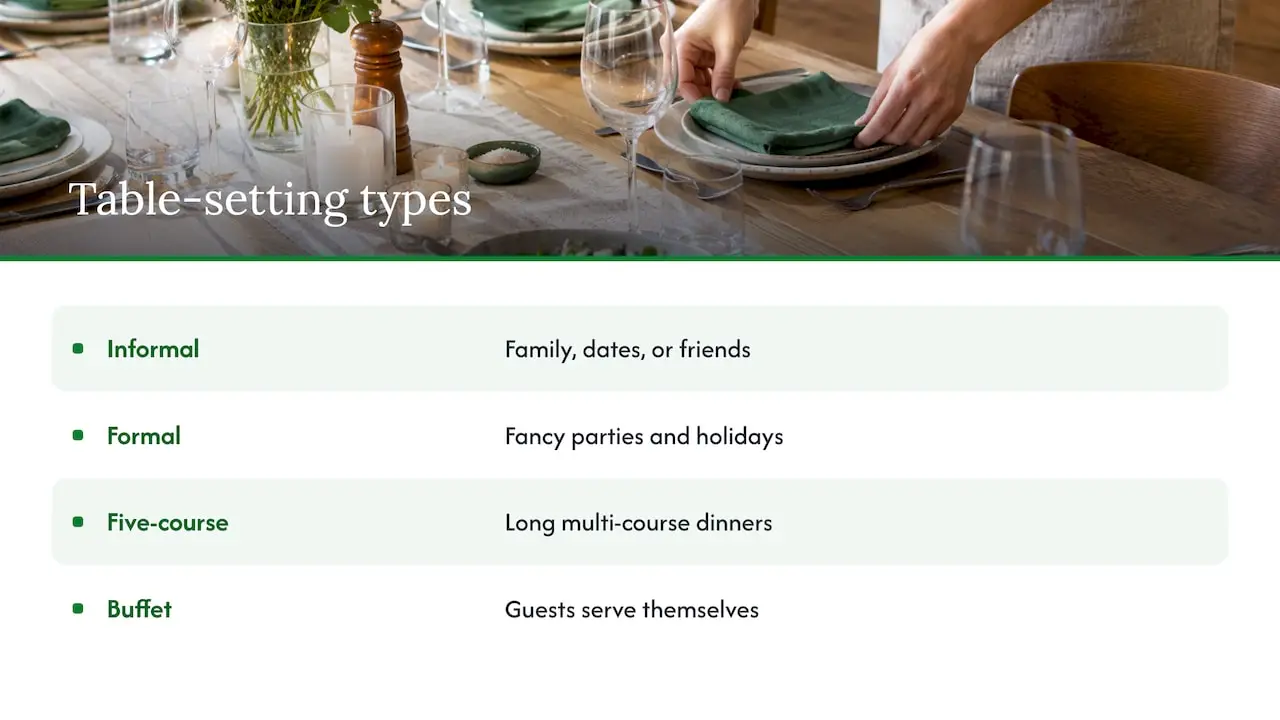
Informal suits a family dinner, a casual dinner date or friends around the table. Emily Post’s guide calls the informal or semi-formal setting wonderful for the classic dinner party, because it feels special without being stiff on a Friday night.
Formal suits fancy dinner parties and holiday meals. It adds a bread plate, dessert utensils, more glassware and often a tablecloth.
The five-course setting, with fish-course silverware and extra wine glasses, belongs to long multi-course dinners. If you are planning one, our guide on how many courses a dinner should have helps you decide what the table actually needs. Buffet settings group flatware in containers or rolled napkins, and they matter when guests serve themselves from a side table.
How to set an informal dinner table, step by step
This is the layout most hosts need. Each step also shows where it usually goes wrong.
- Lay the base. Use a runner with simple placemats for a casual table, as Architectural Digest suggests. Put a placemat in front of each seat. Common mistake: a tablecloth plus a runner plus placemats, which leaves no room for the food.
- Place the plates. The dinner plate goes in the center of the placemat. If you serve salad or soup, stack the salad plate and then the soup bowl on top. Metropolitan Market suggests setting a charger about an inch up from the table edge. Common mistake: pushing plates to the very edge, where they tip when someone leans in.
- Set the forks on the left. The dinner fork sits closest to the plate. An optional salad fork goes to its left, on the outside. Common mistake: setting a fork for a course that is not on the menu.
- Set the knife and spoon on the right. The knife sits next to the plate with the blade facing in. A soup spoon goes to the right of the knife. Spoons appear only when the menu calls for them.
- Add glasses. The water glass goes above the knife, and the wine glass sits to its right. Stemless glassware is acceptable at an informal table, as What’s for Dinner? notes.
- Finish with the napkin. Place it on the plate or under the fork. Architectural Digest also mentions crossing the flatware and tying it with a satin ribbon as a design touch.
A useful rule from Metropolitan Market: space the flatware evenly and line up the bottom edges with the bottom edge of the plate or charger. That detail is what separates a table that looks set from one that looks scattered.
How a formal table differs
A formal table follows the same left-fork, right-knife logic and adds layers. What’s for Dinner? describes the typical formal setup:
- A tablecloth with about a foot of drop, falling to lap level.
- Low, unscented candles and flowers in the center.
- A cloth napkin folded across the dinner plate.
- A bread plate with a butter knife above the forks, and a salad plate to the left of the forks.
- Dessert utensils above the plate.
- Stemmed wine glasses arranged in a triangle with the water glass.
Two details keep the formal look working. Keep candles unscented so they do not compete with the food. Keep the center low so guests can see each other. Adorno’s table design editorial frames formality as mostly a matter of spacing and restraint: aligned plate bases, a low center and one repeated gesture, such as the same glass and the same napkin fold at every seat.
Spacing: how much table does each guest need?
Beautiful place settings fail when guests are crowded. Povison’s seating guide says most designers aim for 24 to 30 inches of table edge per person, with 18 to 24 inches of depth from the edge for plates and glassware and a slim band down the middle for decor.
A few other numbers help:
| What | Guideline | Source |
|---|---|---|
| Edge space per guest | 24 to 30 inches | Povison |
| Clearance between table edge and walls or furniture | At least 36 inches | The Spruce |
| Round formal table diameter | At least 60 inches, often 72 | Houzz |
| Table height with chair seat height | 28 to 30 inches with 17 to 19 inches | Povison |
A worked example: a 72-inch rectangular table seats six comfortably at 24 to 30 inches per person if you seat two at each long side and one at each end. If you plan eight, you need either a longer table or a family-style menu with fewer decorative items, because each person still needs their own plate space.
Round tables suit intimate dinners well. Houzz notes that on a round table each person can face every other guest, which keeps conversation lively. If your room is square, a round table also softens it.
Family-style table setup
Family style means food is placed on the table for guests to serve themselves. It suits pasta, roasted vegetables, salads, sides, bread, casseroles and shared mains, according to Barenthal. It is often easier on the host as well, since there is no plating at the last minute, as Peerspace’s dinner party guide notes.
The setup is different from a plated dinner in one important way: platters go first, decor second. Camille Styles advises finding space for the serving dishes first, then adding details around them, with a patterned cloth or textured placemats to leave the center available. Keep flowers small. If a platter crowds the table, leave it on a nearby surface.
A family-style checklist
- Measure first. Lay out your serving dishes before the table is dressed, so you know how much room they take. Peerspace quotes a designer who measures serving plates ahead of time for exactly this reason.
- Set dinner plates from the start. Metropolitan Market advises this so nobody waits for plates to travel around.
- Choose manageable dishes. Serving platters and utensils should not be so large or heavy that they are hard to pass. On a long table, use duplicates of smaller dishes for each side.
- Label the dishes. Small labels help guests with dietary needs choose confidently, which matters if the menu has been adapted for allergies or preferences.
- Give every dish its own utensil. Barenthal lists a serving spoon for each side, a slotted spoon for foods with liquid, a ladle for sauces and soups, a carving set for large proteins and a board for bread. Without serving tools, guests use personal utensils in shared dishes and the table feels less organized.
- Think about seating. Metropolitan Market suggests the host sit near the kitchen, older guests away from drafts and children interspersed among adults.
Passing etiquette is simple: offer a dish to the person beside you before serving yourself, pass in one direction (traditionally to the right) and take a modest first portion so everyone gets some of each item.
Family style or plated: choose before you set the table
The service style decides what goes on the table, so decide it early.
| Family style | Plated | |
|---|---|---|
| Look and feel | Generous, communal, relaxed | Polished, formal |
| Table space | Needs a clear center and room for platters | Needs only place settings and a low centerpiece |
| Guest control | Guests choose their portions and can taste everything | The kitchen controls portions and pacing |
| Best for | Families, friends, holiday meals | Formal dinners, tightly timed courses |
Our full comparison, family style vs. plated, goes into the trade-offs for events. If you are weighing how guests will be served at a larger gathering, this breakdown of plated versus buffet service is a helpful companion.
A romantic table for two
A dinner for two works best when the table feels small and warm, not like a long table with two chairs lost at either end. Adorno’s advice is to pull both settings to one end or side of a larger table, use two or three candleholders at slightly different heights, keep everything below eye level and lean toward a darker palette, since intimacy reads as depth.
Some details that hold up in practice:
- Keep a hand’s width of clear table in front of each setting, a tip from Home Style Vibes.
- Layer the dinner and salad plates and add one small touch, such as a single leaf on each napkin.
- In a small room, use a single low bowl or three mini clusters instead of one large arrangement.
- Warm candlelight does most of the work. Peerspace quotes designer Liu calling it the number-one descriptor of the tablescape, especially at night.
For the evening around the table, from pacing to the menu, see our chef’s plan for a romantic dinner at home.
Small touches for small groups
Architectural Digest quotes Tracey Rezak of Pomp Parties saying casual tables suit parties of eight or fewer, and that small groups let you spoil your guests with detail. That can mean cutlery in a decorative glass, a printed menu on each plate or a few seasonal candies scattered along the runner.
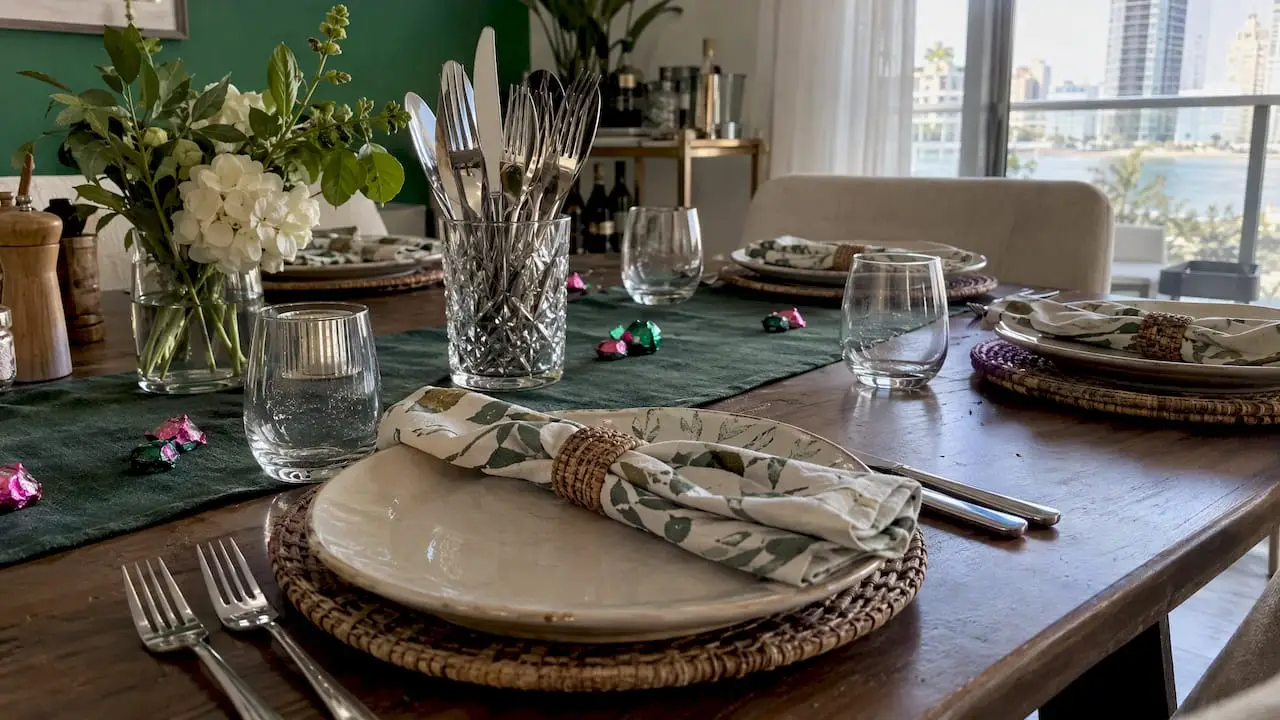
Printed menus pair especially well with a multi-course evening, because guests see the pacing at a glance. If you are building that kind of dinner, read our notes on serving a tasting menu at home.
The day-of sequence
A table is easiest to set when it follows the clock. Our dinner party timeline builds the evening backward from the moment guests sit down. For the table itself, this order works:
- Clear the table and confirm the number of seats, allowing the 24 to 30 inches per guest above.
- Lay the runner or cloth and the placemats.
- Set plates, then flatware, then glasses, then napkins.
- Place the low centerpiece and candles. Check that nothing blocks eye contact across the table.
- Position serving platters and utensils on a side surface, or on the table if you are serving family style.
- Light the candles and adjust the lighting last.
Let the chef handle the menu, so you can focus on the table
A well-set table is only half of a good private dinner. Our private dinners bring a chef-crafted, Haitian-Lebanese inspired menu to your Miami home, made fresh in small batches and never frozen, and tailored to dietary needs.
If you are planning an evening for a couple, a family or a handful of friends, you can talk to the chef directly about the menu, and then set the table around the dishes you have chosen. For larger gatherings, our catering follows the same approach.
Our perspective
We think of the table as part of the menu, not a separate project. When Chef Virginia designs a menu, the first questions are who is sitting down, what they eat and how the food will reach them. A shared platter of something slow-cooked asks for a different table than a plated course, and a dinner for two asks for something smaller and quieter than a dinner for eight.
Our food is made fresh, in small batches, and it is never frozen. It is meant to be eaten at the right moment, and the table is what makes that moment feel unhurried. That is why we encourage hosts to talk to the chef early, before buying linens or candles, so the menu, the service style and the table all agree.
Hosting at home should feel generous. When the food is planned well, the table can stay simple.
Virginia Jiha
FAQ
What is the correct order of forks, knives and spoons?
Forks go on the left and the knife goes on the right with its blade turned toward the plate. A spoon sits to the right of the knife, and only if the menu needs it. Utensils are used from the outside in, so the first-course piece sits farthest from the plate.
Where do the napkin and glasses go?
The napkin goes on the plate or under the forks. The water glass sits above the knife, and the wine glass sits to its right. At an informal table, stemless glasses are fine.
How much space does each guest need at a dinner table?
Plan about 24 to 30 inches of table edge per person, and 18 to 24 inches of depth for plates and glasses. Keep at least 36 inches between the table edge and any wall or furniture so guests can move easily.
How do I set a table for family-style dining?
Set the dinner plates and flatware as usual, then keep the center of the table clear for platters. Give every dish its own serving utensil, label the dishes and keep any flowers small. If a platter does not fit, leave it on a nearby surface and pass it around.
Sources
- 5 Table Settings Every Host Should Know, What’s for Dinner?
- Proper Table Setting 101, Emily Post
- How to Set a Table, Architectural Digest
- Table Settings 101, Metropolitan Market
- Table Setting Ideas, Adorno
- Dining Table Seating Guide, Povison
- 12 Dining Room Layout Ideas, The Spruce
- Key Measurements for Planning the Perfect Dining Room, Houzz
- How to Host a Dinner Party at Home, Barenthal
- Dinner Party Table Settings, Camille Styles
- Your Dinner Party Table Setting Guide for 2026, Peerspace
- 6 Elegant Fall Tablescapes, Home Style Vibes
- Plated vs Buffet: How to Choose for Your Event