Ask every guest about allergies when you send the invitation, and ask before you plan the menu, not after. One short, specific question gets you what you need: which foods cause a reaction, whether cross-contact (traces of an allergen transferred from a surface, utensil or another dish) matters to them, and what would make them comfortable at your table. Done early and kindly, it takes two minutes and protects the evening. At VJ Cuisine, Chef Virginia designs and prepares each menu herself and clients talk to her directly about dietary needs, which is the same conversation this guide helps you have with your own guests.
TL;DR
- Ask when you invite, and before you finalize the menu. Early notice gives you time to shop, read labels and change dishes.
- Ask four things: which ingredients cause a reaction, whether cross-contact is a concern, which brands or products they trust, and what accommodation would help.
- Keep packages or photos of labels, and write ingredients on every dish so guests can check for themselves.
- Build the menu around dishes that naturally avoid the allergen instead of swapping ingredients at the last minute.
- If you cannot make something safe, say so honestly. A guest would rather bring their own dish than take a risk.
Table of Contents
- Why asking early matters more than the menu itself
- When to ask
- What to say: simple wording that works
- The four details to confirm
- Planning an allergy-friendly dinner party
- Shellfish allergy dinner ideas
- What to do when you cannot make it safe
- A pre-dinner checklist
- Let a chef carry the planning
- Our perspective
- Frequently asked questions
- Sources
Why asking early matters more than the menu itself
A menu can be rewritten in an afternoon. A reaction cannot be undone. The nine major allergens named in the FDA’s July 2025 labeling guidance are milk, egg, fish, crustacean shellfish, tree nuts, wheat, peanuts, soybeans and sesame. Several of them hide in sauces, stocks, breading, dressings and spice blends, which is why a host who only learns about an allergy on the day has few safe options left.
The American Academy of Allergy, Asthma & Immunology notes that early communication gives planners and food providers time to consider safe alternatives and plan accommodations. It also describes safer service as the result of hosts or planners, food preparers and guests talking to one another well before the event.
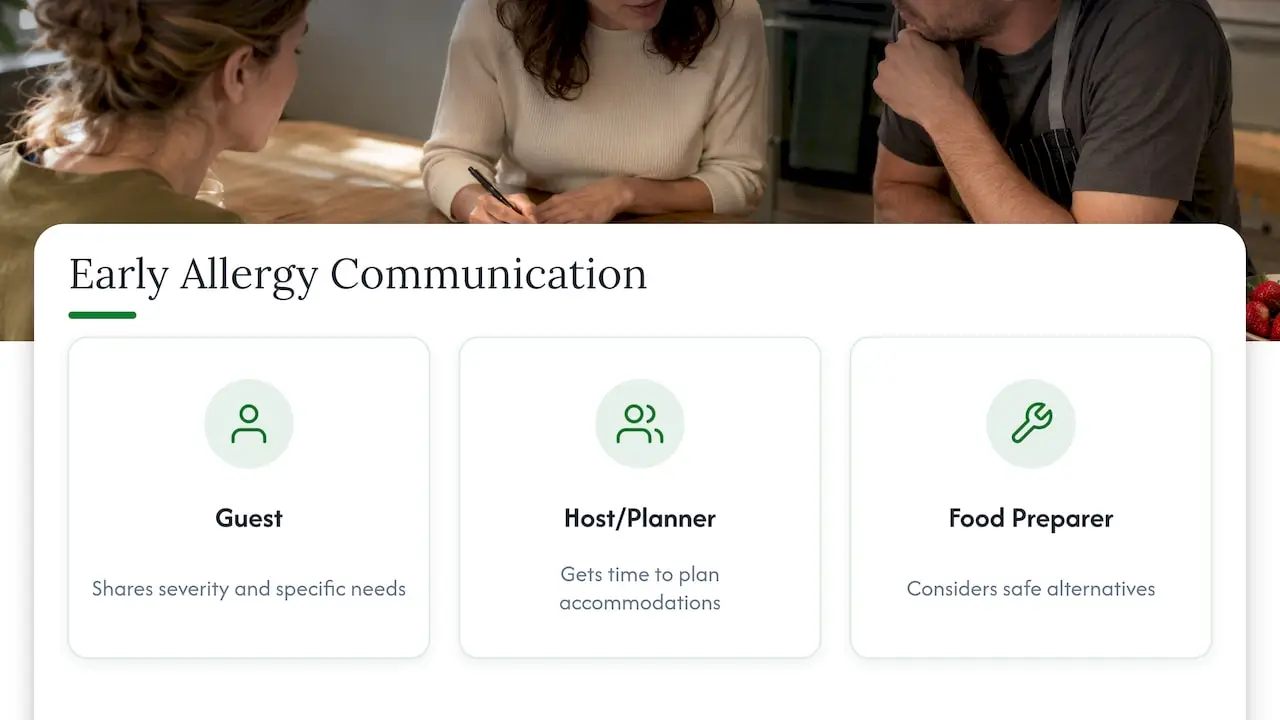
There is a second reason to ask yourself rather than assume. Michigan Medicine’s hosting guidance stresses learning about severity and specific needs directly from the guest, because even trace amounts can cause a reaction in some people. “No nuts” can mean a mild intolerance for one guest and a life-threatening allergy for another. Only they can tell you which.
When to ask
In Brief: ask at the invitation, follow up once the guest list is final, and confirm a few days before the meal.
- With the invitation. Add one line to the invite or the message that goes with it. Indiana University Dining’s November 2026 holiday guide advises hosts to ask about allergies before planning the menu, and that is the right moment: you have not committed to dishes or bought ingredients yet.
- By phone for serious allergies. Michigan Medicine recommends calling guests ahead of time to understand their needs and whether you can meet them. A short call lets the guest explain nuances that a text reply leaves out.
- Once the menu is drafted. Send the dish list back to the guest and ask if anything looks wrong. Guests often spot a risk, like a sauce thickened with wheat, that you would not.
- The day before. A quick “still good with the plan?” catches changes, such as a guest who has since been diagnosed with a new allergy.
If you are juggling a full prep schedule, our dinner party timeline shows where to fit these checkpoints so they do not get squeezed out.
What to say: simple wording that works
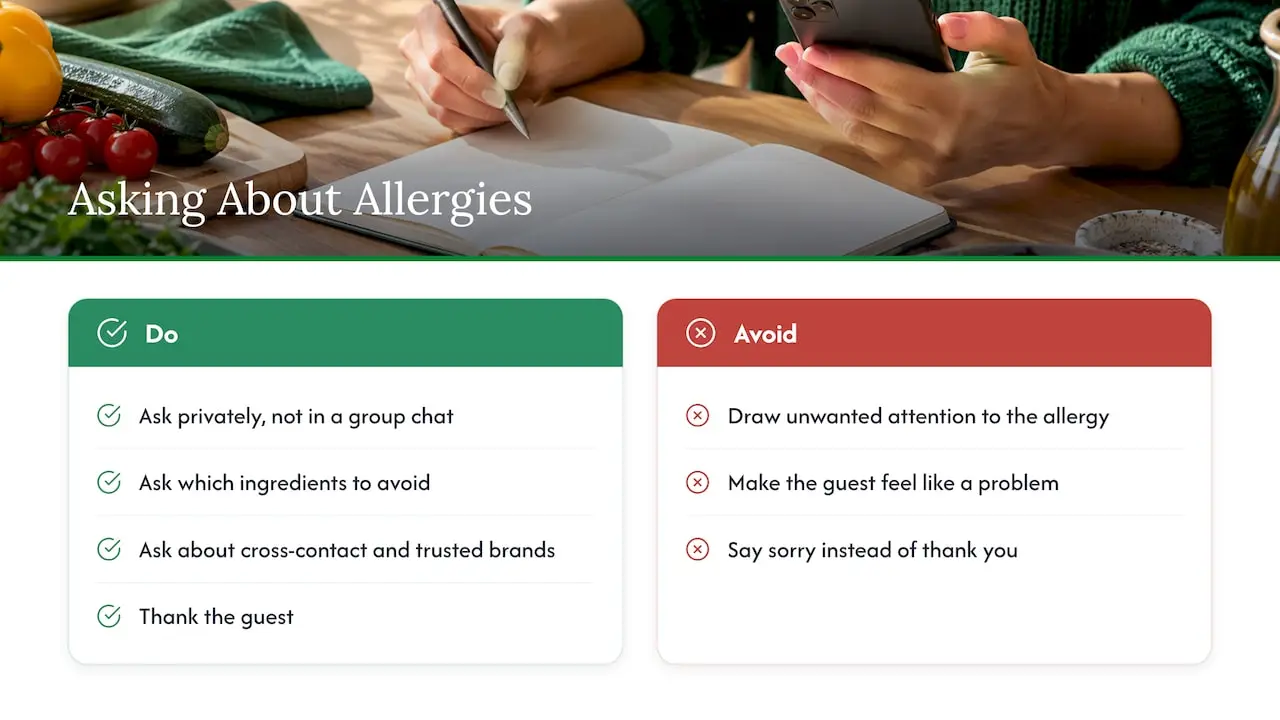
The best messages are warm, specific and short. They do not make the guest feel like a problem to be managed. Indiana University Dining suggests asking how you can accommodate the allergy without drawing unwanted attention to it, so keep the question between you and the guest, not in a group chat.
A written invitation line:
“I’m planning the menu for Saturday and want everyone to enjoy it. Do you have any food allergies or dietary needs I should know about?”
A follow-up for someone who says yes:
“Thank you for telling me. Which ingredients should I avoid, and does cross-contact matter to you? Are there brands you trust? I’d love to cook something you can enjoy fully.”
A call opener:
“I want to get this right for you. Could you walk me through what you avoid and how careful I need to be in the kitchen?”
A note on tone: say thank you, not sorry. The guest is helping you host well.
The four details to confirm
When a guest names an allergy, you need more than the word itself. Indiana University Dining’s guide lists the questions: which ingredients cause reactions, whether cross-contact is a concern, what products or brands they trust, and what accommodation would help. In practice:
- The exact trigger. “Shellfish” can mean crustaceans (shrimp, crab, lobster) only, or it can include mollusks such as clams and mussels. The FDA’s major-allergen list treats crustacean shellfish as its own category, so ask the guest which they avoid rather than guessing.
- Cross-contact tolerance. Some guests can eat food made near an allergen. Others cannot eat anything prepared on the same board, in the same pan or with the same spoon. Ask plainly.
- Trusted brands. A guest may know which broth, chocolate or bread they can safely eat. Using what they already trust removes guesswork.
- Preferred accommodation. Some guests want a fully safe menu. Others prefer to bring a dish and eat with everyone. Ask what feels most comfortable.
If you want more ideas for scripting the conversation, this overview of restaurant food allergy rules shows how clear, advance communication works when someone else prepares the food.
Planning an allergy-friendly dinner party
Once you know what to avoid, plan the menu around it. Do not try to adapt a dish at the last minute.
Choose dishes that are naturally safe
The easiest allergy-friendly meal is one where nothing needs a substitute. America’s Test Kitchen’s September 2023 crowd-cooking guide recommends taking an inventory of each guest’s allergies and cross-contact tolerance, then offering a choose-your-own meal with at least one option at every course. It also suggests flexible, build-your-own components so that you do not need a separate menu for every restriction.
A few examples of how that looks on the table:
- A grain bowl or taco-style spread where proteins, grains, toppings and sauces are served separately.
- Roasted chicken with roasted vegetables, with the sauce served on the side.
- A salad course where dressings and crunchy toppings are passed in separate bowls.
- Fruit-based desserts, so a guest does not have to skip the last course.
If you are cooking for many guests with different restrictions, our guide to Miami catering with gluten-free options covers how to talk through seasoning blends, marinades and cross-contact with a caterer, and the same questions apply at home.
Prevent cross-contact in your kitchen
Cross-contact is the quiet risk. The allergen does not have to be in the dish for the dish to be unsafe: a knife, board or sponge can carry it. The guidance from the sources above agrees on the basics:
- Clean before you cook. The FARE Steps for a Safe Kitchen tells cooks to thoroughly clean counters, cutting boards, knives, bowls and utensils before preparing food for someone with allergies, and to wash, rinse and sanitize surfaces, then let them air-dry.
- Use clean or separate tools. Michigan Medicine recommends separate or thoroughly washed utensils, handwashing and covered foods, and keeping allergen-free foods on the top shelf of the refrigerator so nothing drips onto them.
- Cook the safe dish first. Prepare it before dishes that contain the allergen, while your surfaces and hands are clean, then cover it.
- Keep it above, not below. At the table, Indiana University Dining advises keeping allergy-friendly food separate and above foods that contain allergens so crumbs do not fall into it.
- Serve safely. FARE’s Thanksgiving guidance recommends letting guests with food allergies serve themselves first at a buffet, and using a separate spoon for every dish.
For a refresher on the general kitchen habits behind this, these food safety basics are a good companion read.
Keep labels and write everything down
Appearance tells you nothing. A sauce that looks plain can contain soy, wheat or milk. Keep the packages or take photos of labels, as FARE suggests in its Thanksgiving guide, so you can share ingredient information when a guest asks. Indiana University Dining adds that hosts should keep ingredient lists or written recipes available and label dishes clearly rather than relying on how they look.
Packaged foods sold in the United States must declare the major allergens on the label, but the label covers only the allergens intentionally in that product and only for FDA-regulated packaged foods, as the FDA guidance summary explains. A homemade dish has no label at all, so your handwritten card is the label.
Shellfish allergy dinner ideas
Shellfish is one of the most common requests when hosting in Miami, where seafood shows up on so many menus. The FDA’s list treats crustacean shellfish such as crab, lobster and shrimp as one of the nine major allergens, and the best strategy is to build the meal without it.
Good starting points:
- Grilled vegetables, roasted chicken, quinoa salad, baked sweet potatoes, roasted Brussels sprouts and asparagus are simple menu ideas that avoid the allergen entirely.
- A citrus-marinated chicken or pork main with plantains and rice gives you a festive plate without a seafood element.
- A Haitian-Lebanese style spread, such as spiced roasted meats, herbed rice, hummus-style dips and roasted vegetables, can be built without shellfish from the first step. Ask your guest about sesame, which is also on the major-allergen list, before you choose dips or dressings.
Ingredients to check even in a dish with no visible shellfish:
- Seafood stocks or bouillon, fish sauce and oyster sauce.
- Paella, gumbo or seafood-seasoned rice and soups.
- Pre-made sauces and spice blends, where you should read every label.
- Shared fryers, grills and pans that were recently used for seafood.
Always confirm with the guest first. Some people avoid only crustaceans, while others avoid all shellfish and want no shared equipment.
What to do when you cannot make it safe
Sometimes the honest answer is that you cannot guarantee a safe dish. A severe allergy, a complicated list of restrictions or a small kitchen can make it too risky. Indiana University Dining advises hosts to be transparent if they cannot safely accommodate a guest, and to share ingredient lists so the guest can decide.
In practice, that can sound like:
“I want you to be safe more than I want to impress you. I can make the salad and the roasted vegetables without any of your allergens, but I’m not confident about the dessert. Would you like to bring your own, or should we change the menu?”
Most guests with allergies are used to this and appreciate the candor. What they do not want is false reassurance.
A pre-dinner checklist
Use this list in the days before your event:
- [ ] Asked every guest about allergies at the invitation.
- [ ] Followed up by phone with anyone who reported a serious allergy.
- [ ] Confirmed the exact trigger, cross-contact tolerance, trusted brands and preferred accommodation.
- [ ] Drafted the menu around naturally safe dishes.
- [ ] Sent the menu back to the guest for a quick check.
- [ ] Read every label and kept the packages or photos.
- [ ] Cleaned counters, boards, knives, bowls and utensils before cooking.
- [ ] Prepared the allergy-safe dishes first and kept them covered and separate.
- [ ] Written ingredients on a card for each dish.
- [ ] Planned to let the allergic guest serve first at a buffet.
Let a chef carry the planning
Everything above works, and it also takes time: the messages, the label reading, the second set of utensils, the worry. If you would rather enjoy your own party, we do this work for you. Chef Virginia designs and prepares every menu personally, and you speak with her directly so each dish is tailored to your guests’ preferences and dietary needs. Our meals are small-batch and never frozen, and we serve Miami and the surrounding area.
For a dinner at home, our private dinners put a chef-planned menu on your table. For a larger gathering, catering gives you a menu built around your guest list. If you are planning for a family week of fresh dinners, our meal plans follow the same direct conversation with the chef.
If the guest list is large, our guide to catering portions per person helps you plan quantities so that the safe options do not run out first.
Our perspective
Every allergy conversation we have starts the same way: with a person, not a form. When a client tells us what they or their guests cannot eat, we want to know what they love, what they trust and what a good evening looks like for them. The restriction is only one part of the answer.
That is why we cook in small batches and design each menu ourselves. A menu built for the people at your table can leave out an ingredient from the start, rather than patching it in at the end. We never freeze our meals, and we talk with every client directly, so the details that matter, such as which ingredients to avoid and how careful the preparation needs to be, come from you and go straight to the chef.
Our Haitian-Lebanese heritage gives us a big pantry of herbs, spices, grains, roasted vegetables and slow-cooked dishes that taste generous without depending on any single allergen. A host who feels well looked after is a host who can sit down and enjoy the meal with the guests.
Virginia Jiha
Frequently asked questions
How do I ask about food allergies without sounding intrusive?
Put one open question in the invitation, like “Is there anything I should know about food allergies or dietary needs?” Then follow up privately with the guest who answers. Keeping it one-to-one avoids drawing attention to them in front of other guests, which is what Indiana University Dining advises.
What should I do if a guest has a severe allergy?
Call them before you plan the menu and ask what they avoid, how careful you need to be with cross-contact and what accommodation they prefer. Clean all surfaces and tools before cooking, keep their food covered and separate, and keep labels available. If you cannot make a dish safe, tell them early so they can decide what to do.
Do I need to ask about allergies at a small family dinner?
Yes. Allergies can develop at any age, and a dish you served last year may not be safe now. A one-line message costs nothing, and it keeps a familiar meal from becoming a risk.
What are easy allergy-friendly dinner party ideas?
Build-your-own meals work well: bowls, tacos or platters where proteins, grains, vegetables and sauces are served separately. Roasted chicken, grilled vegetables, baked sweet potatoes and quinoa salad are simple options that avoid several major allergens. Always check the guest’s specific list and read every label.
Can I trust a store label to be safe?
A label tells you which major allergens were intentionally added to a packaged food, not whether your own kitchen introduced one. Check the label each time you buy, because recipes change, and keep the package so the guest can read it too.
Sources
- Food allergies and the holidays: A guide for hosts, Indiana University Dining
- Hosting Guests with Food Allergies: 6 Tips for a Safer Meal, Michigan Medicine
- Event Planning and Food Allergy Awareness, AAAAI
- Tips and Takeaways for Your Teal Thanksgiving, FARE
- Steps for a Safe Kitchen, FARE
- How to Cook for a Crowd with Different Dietary Requirements, America’s Test Kitchen
- FDA final guidance on food allergen labeling requirements, summary
- Allergy-Friendly Meal Planning Tips, Scripps AMG
- Restaurant food allergy rules
- Food safety basics for home cooks