

For a cocktail party, plan on 5 to 7 bite-size pieces per guest for each hour, serve at least four different kinds (one seafood, one cheese, one vegetable, one meat), and keep hot items above 140°F and cold items at or below 40°F. If the party replaces dinner, the numbers roughly double. The rest of this guide shows you how to turn those rules into a menu, a shopping list and a service plan that works in a Miami home, where heat and humidity make timing matter more than usual.
TL;DR
- Quantity: 5 to 7 pieces per person per hour for a standard party; 10 to 12 or more per person if guests are not getting dinner.
- Variety: Aim for four types: fish or shellfish, cheese, vegetable and meat, plus gluten-free and dairy-free choices.
- Size: One or two bites, no plate, no knife, no dripping.
- Safety: Nothing perishable sits out more than 2 hours, or 1 hour above 90°F. Replace empty platters instead of topping them off.
- Easiest path: Make cold items ahead, hold hot items properly, or hand the whole menu to a chef.
Table of Contents
- What counts as an hors d’oeuvre (and what a canapé is)
- How many hors d’oeuvres per person
- Build the menu around four types
- Hot, cold and the two-hour rule
- What to make ahead and what to do on the day
- Our perspective: why small batches matter at a cocktail party
- Budgeting without cheapening the food
- Space, flow and service
- When to hire a private chef
- A quick checklist before the party
- FAQ
- Sources
What counts as an hors d’oeuvre (and what a canapé is)
Hors d’oeuvres (pronounced or-DERVS) are bite-size hot or cold appetizers meant to be eaten with your fingers or minimal utensils. A canapé is one specific type: a base such as bread, toast or a cracker, a spread, a featured topping like meat, cheese or caviar, and a garnish. So every canapé is an hors d’oeuvre, but a stuffed date, a shrimp skewer or a spoon of tartare is not a canapé.
The distinction matters when you plan. Canapés need a sturdy base that will not go soggy, which limits how far ahead you can assemble them. Skewers, stuffed vegetables and small tarts are more forgiving. Many hosts who search for canapé ideas really want the broader category, and that is what we cover here.
How many hors d’oeuvres per person
The number depends on how long the party lasts and whether dinner follows. Caterers commonly recommend 5 to 7 pieces per person per hour for a standard cocktail party, and 10 to 12 or more per person when the appetizers are the meal. Williams Sonoma’s guidance is consistent: for a 2 to 3 hour event without dinner, plan 10 to 12 pieces per person, while a party under 1.5 hours before a seated dinner needs only 4 to 5.
| Type of event | Pieces per person | Notes |
|---|---|---|
| Under 1.5 hours, dinner follows | 4 to 5 | Keep it light so guests stay hungry |
| Standard cocktail party, per hour | 5 to 7 | Add pieces for each extra hour |
| 2 to 3 hours, no dinner | 10 to 12 or more | Include a few substantial items |
A worked example for 20 guests
Say you are hosting 20 people for a two-hour evening party with no dinner. At 10 to 12 pieces each, you need 200 to 240 pieces in total. With four varieties, that is roughly 50 to 60 pieces of each. Williams Sonoma also notes that a wider variety increases total consumption, because guests tend to try one of each. So if you offer six varieties, you may land at the higher end of the range.
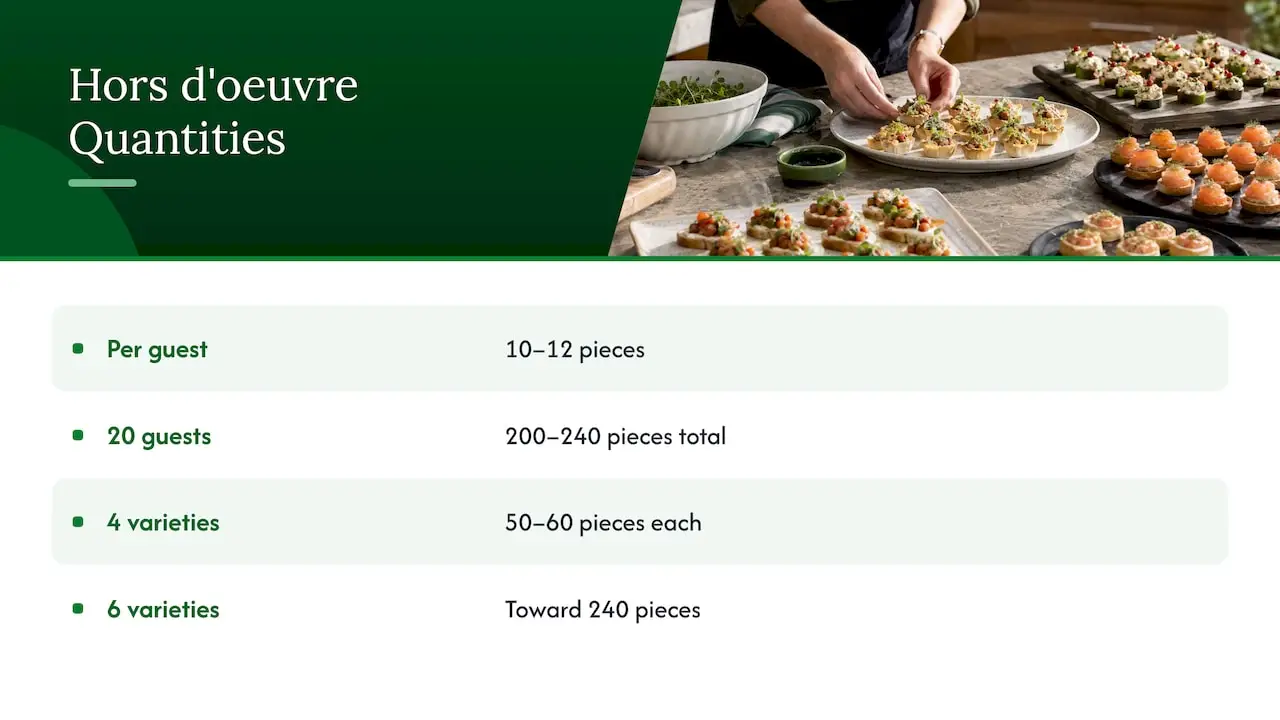
If you want a dinner-party-style answer to “what to feed 20 people,” this is it: pick the duration first, multiply, then divide across varieties. Do not guess by eye.
Guarantee conservatively
If you are ordering from a caterer for a larger event, remember that no-shows happen. The University of Houston’s catering worksheet notes an average no-show rate of about 10% for large events, and advises being conservative with your final guarantee. For a small home party, a few extra pieces cost less than running short.
Build the menu around four types
Chef Daniel Boulud’s advice for a well-rounded party menu is to serve four types of hors d’oeuvres and Julie Blanner, a former caterer and event planner, echoes the idea of mixing proteins and covering dietary needs such as gluten-free and dairy-free. The four types:
- Fish or shellfish: shrimp, seared tuna, smoked salmon, crab.
- Cheese: a warm baked bite or a cool whipped one.
- Vegetable: something that is not just a crudité tray.
- Meat: a skewer, a meatball, a small kebab.
Then add a temperature balance. Two cold items that can be finished before guests arrive, one or two hot items, and one item that holds well at room temperature for a short time. That mix keeps you out of the kitchen.
Ideas that suit Miami
Miami parties lean toward seafood, citrus and herbs, and the weather favors food that is cool and bright. A few directions:
- Seafood: chilled shrimp with a lime and herb dip, or ceviche in small spoons. Stone crab season in Florida starts October 15 and runs through May 1, so claws are a seasonal showpiece for a fall or winter party, usually served chilled on ice.
- Cheese: labneh rolled in za’atar and served on cucumber rounds, or small bites of halloumi with honey.
- Vegetable: stuffed grape leaves, roasted eggplant dip on endive leaves, or crisp plantain rounds with a topping. Our guide to Lebanese mezze you can cook at home covers three recipes that translate well to small bites.
- Meat: spiced beef or chicken skewers, kafta bites, or small meatballs with a bright sauce.
Many of these are naturally gluten-free, but cross-contact in the kitchen still matters. If a guest has celiac disease, tell your chef or catering team in advance and read our notes on Miami catering with gluten-free options.
Sizing: one or two bites, no plate
Catering professionals consistently say that pieces should be one or two bites so guests can eat standing up, without a plate or a table. This keeps the room social and your cleanup simple. Use a quick test: if a guest cannot eat it neatly while holding a drink in the other hand, it belongs at a seated course instead.
That rules out some popular choices. Anything with a long drip, a sauce that needs a spoon, or a bone to dispose of should be redesigned or skipped. Provide small napkins, a discreet place for toothpicks and skewers, and a bowl for shells or pits if you serve them.
Hot, cold and the two-hour rule
Food safety is the part of party planning that hosts most often skip, and Miami’s climate makes it more relevant. The USDA’s Food Safety and Inspection Service says perishable food must be kept hot at 140°F or above, or cold at 40°F or below. Between 40°F and 140°F is the “Danger Zone,” and perishable food left there for more than 2 hours, or 1 hour when the temperature is above 90°F, should be discarded. The USDA also explains that bacteria multiply quickly at these temperatures, which is why “keeping it warm” on a counter is not enough.
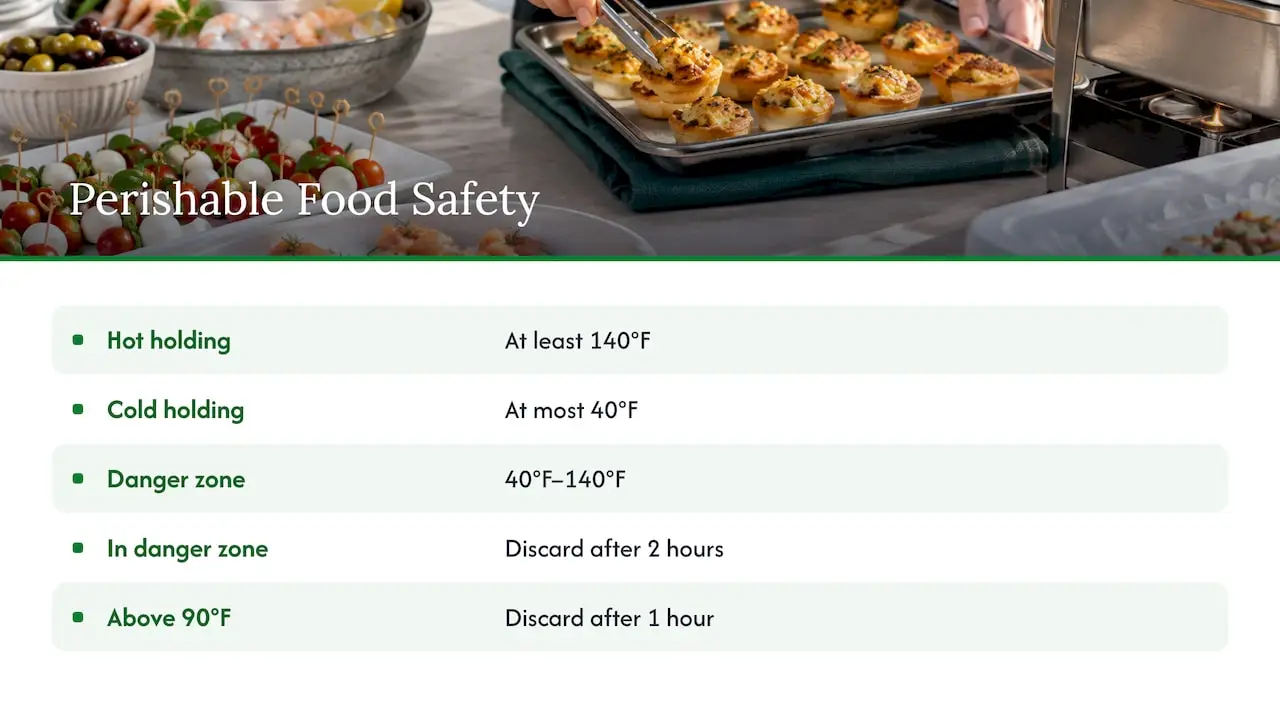
If you are hosting on a patio or by a pool in Miami, the 1-hour limit above 90°F is the one that applies. Our guide to outdoor dining at home goes into shade, timing and holding food in the heat.
Practical rules for the host
- Hot food: use chafing dishes, warming trays or an oven set to hold above 140°F. Check with a food thermometer, not by touch.
- Cold food: nest platters in ice, or keep trays in the refrigerator and bring out small batches.
- Refill smartly: swap an empty platter for a fresh one rather than adding to a half-full one. This avoids mixing old and new food that guests have handled.
- Start a clock: note when each platter goes out. After 2 hours (1 hour in hot weather), it is done.
- Cook to temperature: the same FSIS pages stress that hot items must be reheated properly, so use a thermometer for anything you reheat.
FoodSafety.gov publishes guidance for catered and DIY wedding food that applies to any party where food is out for hours. If anyone in your group is pregnant, elderly, very young or immunocompromised, follow the stricter side of these rules and ask your doctor about specific foods such as raw seafood.
What to make ahead and what to do on the day
The goal is that the last 30 minutes before guests arrive involve almost nothing. Work backward from the start time, which is the logic behind our dinner party timeline.
| When | What to do |
|---|---|
| 2 to 3 days before | Make dips, spreads, marinades and sauces; order seafood |
| 1 day before | Prep vegetables, marinate proteins, bake pastry shells |
| Morning of | Assemble cold items that do not wilt; set up serving pieces |
| 1 hour before | Prepare ice, label dishes with allergens, preheat the oven |
| 30 minutes before | Cook or reheat hot items; plate the first batch only |
| During the party | Replace platters in small rounds; check temperatures |
If you plan a Mediterranean-style menu, our make-ahead plan for a Mediterranean dinner party uses the same logic.
Our perspective: why small batches matter at a cocktail party
We cook for Miami households, and the most common mistake we see in cocktail party food is scale without care. A tray of 200 identical frozen pieces reheated at once looks efficient, but it creates two problems: the food peaks at one moment and declines afterward, and the whole batch lands in the temperature danger zone together.
Our approach is the opposite. Everything we make is small-batch and never frozen, and Chef Virginia designs and prepares each menu herself, drawing on a Haitian-Lebanese heritage that gives us a pantry of spice blends, marinades, herbs, pickles and fried bites that guests do not see at every party. We send food out in rounds so that the last plate tastes like the first.
We also talk to every client directly before the menu is set. That conversation is where we ask about gluten-free needs, dairy, nuts, shellfish, heat tolerance and who is eating what. A good hors d’oeuvre menu should never leave one guest with a single sad plate of raw vegetables while everyone else eats well.
Our advice, if you cook it yourself: pick fewer items and do them well. Four varieties, with at least one that is gluten-free and one that is vegetarian, will serve most groups better than ten mediocre ones.
— Virginia Jiha
Budgeting without cheapening the food
Catering professionals advise that you should not cut a budget by lowering the quality of the food. Instead, choose more affordable ingredients or creative alternatives to expensive items. For hors d’oeuvres, that looks like this:
- Use chicken thigh or spiced beef in place of beef tenderloin, and spend the savings on one standout seafood item.
- Build vegetable bites on seasonal produce rather than out-of-season imports.
- Make the sauces and dips yourself; they carry the flavor.
- Offer one premium item, such as stone crab in season, and keep the rest approachable.
If you are comparing service styles for a larger event, our piece on prix fixe vs à la carte explains how each affects cost and pace. When you ask any caterer for a quote, read the banquet event order carefully: it should list the date, service timing, deposit, billing, cancellation terms and gratuity, as the University of Houston worksheet advises.
Space, flow and service
Food placement changes how much people eat and how comfortable the room feels. Spread stations across the space rather than putting everything on one table, so guests do not queue. Keep drinks away from the main food station. For passed items, a small team passing three or four varieties in rounds keeps the food fresh and the conversation moving.
Industry planning sheets suggest that reception space ranges from a bare minimum of 6 to 7 square feet per person to 10 or more square feet for comfortable circulation. For a home party, that means a 20-person gathering feels right in about 200 square feet of open floor, including patio space. If your living room is smaller, plan for a wave of guests moving between indoor and outdoor areas.
When to hire a private chef
Doing it yourself makes sense for a gathering of 10 or fewer with simple items. Consider a chef when:
- You are hosting 15 or more guests and want hot items served in rounds.
- Guests have several dietary restrictions, including celiac disease or allergies.
- You want a menu with a real point of view instead of a grocery-store tray.
- You would rather be a guest at your own party.
We offer boutique catering in Miami for cocktail parties and small events, and private in-home dinners for couples and groups who want a seated menu. Both begin with a conversation with the chef about your guests, your space and your timing. We do not publish set prices, so ask us for a quote based on your guest count and menu. If you are planning a holiday party, see our Christmas catering in Miami menus.
For the weeks between events, our chef-crafted meal plans keep everyday dinners fresh, and our blog has more on Miami meal planning and catering.
A quick checklist before the party
- Total pieces calculated from hours and whether dinner follows.
- Four types covered: seafood, cheese, vegetable, meat.
- At least one gluten-free and one dairy-free option, labeled.
- Every item eaten in one or two bites, no plate required.
- Hot holding equipment tested; ice and coolers ready.
- Thermometer on hand, and a note of when each platter went out.
- Extra platters prepared so that you can swap rather than top off.
- Napkins, a trash spot and a place for skewers.
FAQ
How many hors d’oeuvres per person do I need?
For a standard cocktail party, plan on 5 to 7 pieces per person per hour. If the party replaces dinner, plan 10 to 12 or more per person. If dinner follows a short reception of under 1.5 hours, 4 to 5 pieces is enough.
How many types of appetizers should I serve?
Four is a good minimum for a larger group: one fish or shellfish, one cheese, one vegetable and one meat, per Daniel Boulud’s advice. Add gluten-free and dairy-free choices so every guest has several options. More varieties also tend to increase how much each guest eats.
How long can hors d’oeuvres sit out?
Perishable food should not stay out more than 2 hours, or 1 hour if the temperature is above 90°F, according to the USDA’s Food Safety and Inspection Service. Keep hot food above 140°F and cold food at or below 40°F. Swap in fresh platters rather than topping off old ones.
What is the difference between a canapé and an hors d’oeuvre?
Hors d’oeuvre is the umbrella term for small hot or cold bites. A canapé is one kind, built on a base such as bread or a cracker, with a spread, a topping and a garnish. A skewer or a stuffed vegetable is an hors d’oeuvre but not a canapé.
Can a private chef cater a small cocktail party at home?
Yes. We cook small-batch menus for Miami households and tailor them to dietary needs after speaking with you directly. Tell us your guest count, the length of the party and any allergies, and we will build a menu from there through our catering page.
Sources
- 25 Easy Hors d’Oeuvres Recipes from a Caterer, Julie Blanner
- How Many Hors d’Oeuvres Per Person, The Takeout
- Estimating Quantities of Hors d’Oeuvres, Williams Sonoma
- How to Serve Showstopping Hors d’Oeuvres, According to Daniel Boulud, Food & Wine
- Safe Handling of Take-Out Foods, USDA Food Safety and Inspection Service
- Don’t Let Bacteria Crash Your Party, USDA
- Food Safety Tips for Catered and DIY Wedding Food, FoodSafety.gov
- Catering Worksheet, University of Houston
- Catering Quick Numbers
- Where to Find the Best Stone Crabs in Miami, Fine Dining Lovers