
A chef-prepared anti-inflammatory meal plan means ready-to-eat, small-batch meals designed by a private chef and delivered to your door or served in-home, built around Mediterranean-style ingredients that support lower inflammation. It suits anyone who wants the health benefits of this eating pattern without shopping, cooking, or meal-prepping. Services like VJ Cuisine in Miami build exactly this: fresh, never-frozen meals tailored to your dietary needs.
Key Takeaways:
- A chef-prepared anti-inflammatory meal plan delivers fresh, small-batch Mediterranean-inspired dishes that are fully cooked and ready to reheat, avoiding freezer textures.
- To ensure safety, meals must be kept below 40°F during delivery, eaten within 3 to 4 days, and reheated to an internal temperature of 165°F.
- Delivery frequency of twice weekly balances freshness with safety, minimizing the risk of bacterial growth while maintaining meal quality.
- Customization is key, with private chefs able to adjust ingredients for allergies, medical conditions, and dietary preferences, unlike generic meal kits.
- Food safety during delivery is critical, requiring inspection of packaging, ice packs, and timing to avoid unsafe bacterial proliferation.
|
Fresh Meals Without Meal Prep
VJ Cuisine creates fresh, small-batch meal plans with personalized service for busy Miami professionals and families. Explore VJ Cuisine |
What Does a Chef-Prepared Anti-Inflammatory Meal Plan Include?
A chef-prepared anti-inflammatory meal plan arrives fully cooked, portioned, and ready to reheat. There is no chopping, no grocery run, no guessing whether a recipe hits the right macros. The best versions come from small-batch kitchens that never freeze their food, which preserves both texture and the nutrient profile of fresh vegetables and lean proteins.
The anti-inflammatory framing usually draws from Mediterranean-style eating, since that pattern has the deepest evidence base for reducing inflammatory markers. A typical weekly rotation leans on:
- Fatty fish like salmon or sardines for omega-3 fats
- Extra-virgin olive oil instead of seed oils or heavy butter
- A wide base of colorful vegetables and legumes for fiber and polyphenols
- Whole grains such as farro, quinoa, or brown rice over refined starches
- Herbs, garlic, and citrus for flavor instead of excess sodium or sugar-laden sauces
What separates a private chef from a mass-market meal kit is customization. A real chef can swap ingredients for a peanut allergy, adjust sodium for someone managing blood pressure, or build a lower-fiber version for a client dealing with an IBS flare, all while keeping the same anti-inflammatory backbone.
Why Does Chef-Prepared Delivery Improve Results for Busy People?
Diet quality matters less than diet consistency, and consistency is exactly what most people struggle to maintain. A meta-analysis of 33 randomized controlled trials covering 3,476 participants found that groups following a Mediterranean dietary pattern showed significant reductions in hs-CRP, IL-6, and IL-17, three of the most studied inflammatory biomarkers. A separate umbrella review of systematic reviews reached a similar conclusion: Mediterranean and vegetarian patterns consistently correlate with lower CRP and IL-6 levels across dozens of studies.
The evidence in one line: Mediterranean-style eating patterns show measurable reductions in three major inflammatory markers across large-scale reviews, not just in single studies.
That evidence describes a pattern, not a single miracle ingredient. Patterns only work if you actually follow them for months, and that is where most home cooks fall off. Grocery shopping, meal planning, and nightly cooking are the real barriers, not knowledge of what to eat. A personal chef removes that entire layer of friction, which is why chef-prepared meals tend to produce better long-term adherence than a printed meal plan sitting in a kitchen drawer.
None of this replaces medical care. For clients managing autoimmune conditions or chronic pain, a consistent anti-inflammatory pattern works best as a companion to whatever a physician has already prescribed, not a substitute for it.
How Should You Judge Food Safety and Delivery Temperature?
This is the part most people skip, and it’s the part that matters most with preservative-free food. The USDA Food Safety and Inspection Service defines the “danger zone” as 40°F to 140°F, the range where bacteria multiply fastest.
Perishable meals left at room temperature for more than 2 hours, or more than 1 hour above 90°F, should be thrown out. No exceptions, no “it still smells fine.”
Here’s what to check every time a delivery arrives:
- Confirm cold storage. Meals should be refrigerated at 40°F or below the moment they’re in your hands.
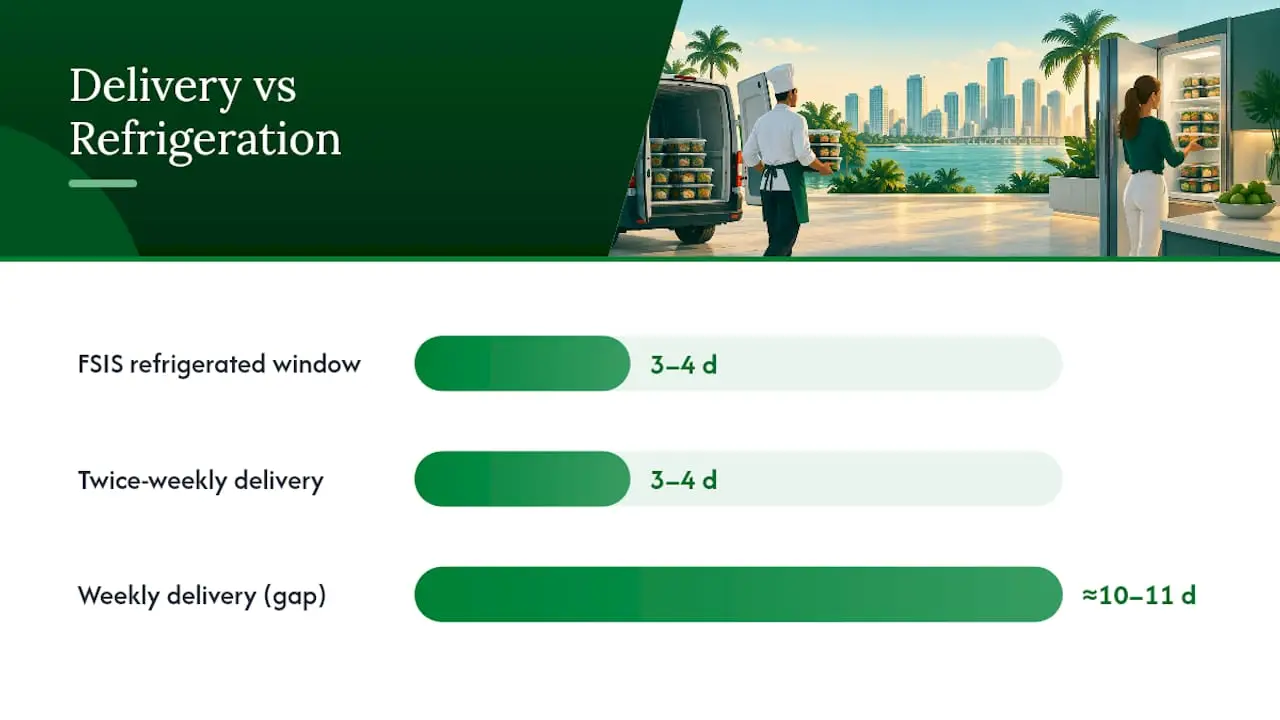
- Respect the shelf-life window. Preservative-free meals should be eaten within 3 to 4 days of preparation, per FSIS guidance.
- Reheat thoroughly. Bring meals to an internal temperature of 165°F before eating.
- Inspect the packaging. Containers should feel cold to the touch, and any included ice packs should still be at least partially frozen.
- Watch the clock. A delivery that sat on a porch for hours in Miami heat has likely crossed into unsafe territory regardless of how it looks.
The FDA’s guidance on last-mile delivery specifically calls out insulated packaging, active temperature monitoring, and preventive controls as the standard third-party and local delivery services should meet. If a delivery arrives warm, with melted ice packs, or hours later than promised, the safest move is to reject it and contact the service, not to taste-test your way to a decision.
How Often Should You Order Small-Batch Meals?
Twice-weekly delivery tends to be the sweet spot for preservative-free, small-batch cooking. It keeps every meal well inside the 3 to 4 day refrigerated window FSIS recommends, and it means you’re always eating food that was cooked days, not a week and a half, ago.
Freezing is an option, but it’s a trade-off. Fresh, never-frozen preparation is part of what makes chef-cooked meals taste like a restaurant plate instead of a reheated one, and freezing softens vegetables and changes the texture of proteins like fish. Chefs who blast chill meals immediately after cooking can sometimes extend quality safely, since rapid chilling moves food through the danger zone faster than a standard refrigerator can.
Cadence depends on your household:
- Single professionals often do well with two smaller deliveries a week timed around a predictable schedule.
- Families may need larger twice-weekly drops or a midweek top-up to avoid running out by Thursday.
- Couples with variable schedules sometimes prefer weekly delivery paired with one or two meals frozen deliberately for backup, understanding the texture trade-off going in.
Pro Tip: Set a recurring calendar reminder the day before each delivery so someone is actually home or the drop-off spot is clear. A missed delivery sitting in Miami heat for three hours is a wasted meal and a safety risk.
How Do You Choose a Private-Chef Meal Service?
Not every “anti-inflammatory” menu is built with the same rigor. Before you commit to a plan, ask these questions:
- Where do the ingredients come from, and how fresh is “fresh”? A vague answer is a warning sign.
- Can I see a sample weekly menu before ordering? A confident service will hand this over without hesitation.
- What temperature do meals arrive at, and how is that maintained in transit? Look for specifics like insulated bags, ice packs, or refrigerated vehicles, in line with FDA sanitary transport standards.
- What’s the stated shelf life? Anything claiming safe consumption well past 4 days for a preservative-free product deserves skepticism.
- Can the chef accommodate my specific restriction? A real allergy or condition, whether celiac disease, gout, or IBS, should get a real answer, not a generic “we can probably do that.”
Trust signals worth weighing: a named chef with documented culinary background, transparent handling practices, and client feedback that speaks to consistency rather than a single great meal. Red flags include cagey answers about temperature control, shelf-life claims that stretch past what food safety guidance supports, and any reluctance to explain how meals travel from kitchen to your door.
What Does a Sample Anti-Inflammatory Day Look Like?
A single day on a chef-built anti-inflammatory plan might look like this:
Breakfast: Greek yogurt with walnuts, blueberries, and a drizzle of honey, or a vegetable and herb egg frittata cooked in olive oil.
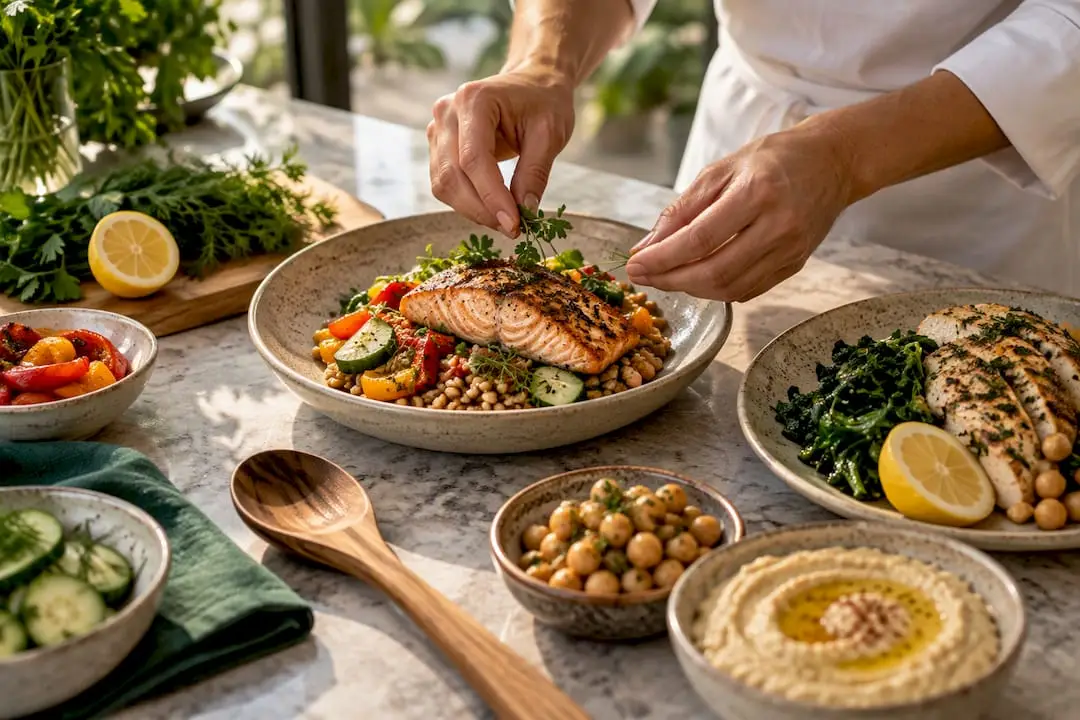
Lunch: Grilled salmon over a farro salad with roasted peppers, cucumber, and a lemon-olive oil dressing.
Dinner: Herb-marinated chicken thighs with sautéed greens and a side of chickpeas tossed in garlic and cumin.
Snacks: Hummus with raw vegetables, or a small handful of almonds and dried apricots.
Every element does double duty: the olive oil and salmon deliver omega-3s, the legumes and vegetables bring fiber and polyphenols, and lean, herb-forward proteins keep sodium and processed fat low without sacrificing flavor. A skilled private chef can rotate this same structure through Haitian and Lebanese-inspired dishes, swapping in spiced lentils, grilled fish with tahini, or root-vegetable stews, so the anti-inflammatory pattern never feels repetitive. The point isn’t a rigid template. It’s a consistent framework flexible enough to hold your actual taste preferences.
How Does Diet Fit With Exercise and Sleep for Reducing Inflammation?
Food is one lever, not the only one. Chronic inflammation responds to a handful of inputs working together, and diet does the most good when it isn’t fighting against poor sleep or a completely sedentary routine.
Sleep debt raises inflammatory markers on its own, so even a well-designed anti-inflammatory meal plan won’t fully offset five hours of sleep a night. Movement matters too, though it doesn’t require a punishing routine. Regular moderate activity, walking, swimming, resistance training two or three times a week, works alongside dietary changes rather than in competition with them.
The practical takeaway for someone already paying for chef-prepared meals: don’t treat food as the entire solution. Pair consistent anti-inflammatory eating with a sleep schedule you can actually stick to and movement you don’t dread. The meals handle the nutrition variable reliably: what surrounds them, rest and activity, determines how much of that benefit you actually feel week to week.
Chef Perspective: Why We Build Small-Batch Anti-Inflammatory Menus
People assume an anti-inflammatory diet has to taste like punishment: bland proteins, steamed vegetables, nothing you’d actually look forward to eating. That assumption is what pushes most people off the wagon within a few weeks. My approach with VJ Cuisine starts from the opposite direction: build genuinely flavorful food first, using Haitian and Lebanese technique and spice work, and let the anti-inflammatory framework live inside that flavor rather than instead of it.
Personalization is the other half of it. A menu built for a client managing joint pain looks different from one built for a family just trying to eat better, and neither should feel like a compromise. What I hear most often from clients isn’t about a specific ingredient. It’s that they finally stopped thinking about dinner altogether.
How VJ Cuisine Helps You Eat This Way Without the Work
Private chef services offer an alternative to grocery shopping and nightly cooking for anti-inflammatory eating with fresh, never-frozen meals built around specific dietary needs, delivered on a schedule that fits your week instead of one you have to plan your week around.
The Meal Plans service covers the everyday version of this: weekly rotations built on Mediterranean-style ingredients, customized for allergies or medical restrictions, and prepared in small batches so nothing sits around losing flavor. If you’re hosting rather than stocking a fridge, Private Dinners brings the same chef-driven approach to a single evening at home, and Catering extends it to small gatherings and events.
Getting started can involve requesting a sample menu or contacting the service provider to discuss dietary restrictions before the first delivery. Explore the current meal plan options and get a first week scheduled around whatever cadence fits your household.
Sources
- Leftovers and Food Safety | Food Safety and Inspection Service
- Mediterranean diet reduces inflammation in adults: a systematic review and meta-analysis of randomized controlled trials
- Dietary patterns associated with anti-inflammatory effects: an umbrella review of systematic reviews and meta-analyses
- FDA highlights best practices for food safety in online delivery