
Seasonal menu planning means deciding your meals a season at a time instead of a week at a time. You choose a short list of dishes built around ingredients at their best, rotate them, and adjust four times a year. In Miami, where the calendar runs on heat, humidity and rain more than on snow, the method works the same way. You just have to read the seasons locally.
This guide covers how to build a seasonal menu for your household, how to adapt it for a dinner party or catered gathering, and what Miami’s produce calendar can add to it. It also covers when it makes sense to hand the whole job to a chef.
TL;DR
- Plan by season, not by week: pick 15 to 20 dishes you like, rotate them, and review them four times a year.
- Start from what is good right now, then choose recipes. Ingredient-first planning cuts waste and improves flavor.
- In Miami, follow local produce windows rather than a national spring-summer-fall-winter chart. Fruit & Spice Park publishes a month-by-month list.
- For catering, a seasonal menu with a repeating cycle keeps prep predictable and the food consistent.
- If you would rather not plan at all, a private chef can design the rotation and deliver it fresh.
Table of Contents
- What seasonal menu planning actually is
- Why Miami needs its own seasonal calendar
- How to build a seasonal menu in six steps
- Seasonal menu ideas for Miami
- Seasonal catering menus: planning for a gathering
- Perspective: why we cook in small batches and by season
- When it makes sense to hand it to a chef
- Common mistakes in seasonal menu planning
- FAQ
- Sources
What seasonal menu planning actually is
Most advice on this topic splits into two camps. One is the household version: a parent or busy professional who wants fewer nightly decisions. The other is the restaurant version: an owner who changes the menu to follow the market. The two share the same logic. A menu built around a defined set of dishes, refreshed on a schedule, takes less effort to run than one improvised daily.
The household version is sometimes called “set it and forget it.” You write down the meals you are excited to cook this season, and that list becomes a reference guide rather than a rigid schedule. When someone asks what is for dinner on Tuesday, you pick from the list instead of starting from a blank page.
The benefits are practical:
- Fewer decisions. Choosing from a short list removes most of the daily deliberation.
- Better value and flavor. The University of Washington’s wellness program notes that seasonal produce can offer better prices and flavor, and that planning ahead can reduce food waste and stress.
- Less waste. When you buy for a known set of dishes, fewer ingredients wilt in the drawer.
- More variety over a year. Four short lists, each different, beat one long list that you stop using.
Why Miami needs its own seasonal calendar
Most seasonal guides online are written for places with a cold winter and a short growing season. They tell you to roast squash in October and wait for strawberries in June. That framework does not map neatly onto South Florida, where the growing calendar is shaped by heat, rainfall and a long tropical fruit season.
The county’s own Fruit & Spice Park lists what grows each month. In January, for example, that includes avocado, coffee and star fruit. In July it includes longan, mango and pineapple. That one page already shows how different a South Florida pantry looks from a northern one, and how the best ingredients shift from month to month.
A useful way to think about it is to split the year into the seasons you actually feel:
| Miami season | Rough months | What changes in the kitchen |
|---|---|---|
| Dry, mild season | November to April | Outdoor dining returns, salads and grilling dominate, and hosts plan more gatherings |
| Hot, wet season | May to October | Lighter dishes, cold preparations, tropical fruit, and less time at the stove |
These months are a general rule of thumb for planning, not a harvest calendar. For specific ingredients, check the park’s monthly list, a farmers market, or ask the person selling you the produce what is running well that week.
You can still keep four seasonal menus if you like the rhythm. Many Miami households do a “winter” menu for the cooler, drier months, a “spring” menu for the shift into heat, a “summer” menu for the wet season, and a “fall” menu that bridges back to entertaining and holidays. What matters is that each menu is anchored in local ingredients and local habits.
How to build a seasonal menu in six steps
This is the process we recommend whether you cook at home or are planning for guests.
1. Define your produce window
Start with what is good now. Look at the monthly list from a local source, visit your closest market, or note what your grocer is featuring at the front of the store. Write down eight to twelve ingredients that look fresh and are reasonably priced.
This is “ingredient-first” planning: you pick meals based on what is available, rather than picking meals and hunting for ingredients. If you enjoy growing things yourself, even a small tray of microgreens grown at home can add a fresh garnish or salad base that you did not have to shop for.
2. Check what you already have
Before you add anything, look through your pantry, fridge and freezer. A seasonal plan should use staples you already own: rice, beans, spices, oils, grains, canned tomatoes. Keeping a stable set of basics means the seasonal part of the plan only has to cover fresh ingredients.
3. Set your dietary goals
Write down any constraints before you pick dishes: allergies, a diabetic-friendly approach, low-carb preferences, high-protein training needs, or a child who refuses anything green. A plan that ignores these gets abandoned quickly. If you want examples of how constraints change a plan, our guides to a diabetic-friendly meal plan, keto meal plan ideas and athlete meal plans show three different approaches.
4. Choose a core library of dishes
Pick 15 to 20 dishes: a mix of proteins, vegetarian mains, grain bowls, soups or salads, and a few things that reheat well. Choose recipes that are versatile, meaning one base can become two meals. Roasted chicken one night becomes a salad or a wrap the next. A pot of rice or beans stretches across several dinners.
A good library has a few categories:
- Two or three quick weeknight dinners (30 minutes or less)
- Two or three dishes that improve as leftovers
- A weekend project meal you look forward to
- A couple of light options for the hottest weeks
- One or two dishes you can scale up for guests
5. Map the dishes to a rotating template
Now place your dishes into a four-week rotation. You do not have to plan seven dinners a week. The organizing blog Organizing Moms suggests planning five meals rather than seven, which leaves room for leftovers, takeout nights and plans that change. That advice also helps you avoid overbuying.
A simple template looks like this:
| Week | Night 1 | Night 2 | Night 3 | Night 4 | Night 5 |
|---|---|---|---|---|---|
| 1 | Fish and citrus slaw | Chicken and rice | Vegetable stew | Grilled meat and salad | Pasta or grain bowl |
| 2 | Grain bowl | Soup or stew | Roasted chicken | Seafood dish | Flexible night |
| 3 | Repeat favorite from week 1 | New dish | Leftover remix | Weekend project | Flexible night |
| 4 | Repeat favorite from week 2 | New dish | Light summer plate | Grill night | Flexible night |
The exact dishes matter less than the shape: two repeats, two new dishes, and a flexible slot each week.
6. Review and adjust
At the end of each season, look at what worked. Health Canada suggests keeping old meal plans and favorite recipes in a binder or on a computer so you can reuse the ones you liked. Do the same: keep a short log with three columns, what you would repeat, what you would drop, and what you want to try. Next season’s plan starts from that log instead of from nothing.
Seasonal menu ideas for Miami
Because Miami’s produce calendar differs from most guides, here are ways to build dishes around what the region does well. Treat these as starting points and confirm what is at its best that week.
Cooler, drier months (roughly November to April)
- Avocado is on the park’s January list, so it fits well into salads, toast, bowls or a green sauce for grilled fish.
- Star fruit, sliced thin, brightens a citrus salad or a plate of seared seafood.
- Slow braises and stews work in the cooler evenings, especially when you can make a double batch.
- This is also entertaining season, so build one dish you can scale for a dozen guests.
Hot, wet months (roughly May to October)
- Mango and pineapple appear on the park’s July list. Use them in salsas, marinades, chilled soups and glazes for chicken or shrimp.
- Longan, also listed for July, makes a simple fruit course or a garnish for a cold dessert.
- Cold preparations, such as chilled noodle salads, ceviche-style plates or grain salads, reduce time at a hot stove.
- Marinades and seasoning blends do much of the work: a bright, acidic marinade with fresh herbs and citrus keeps grilled proteins lively without heavy sauces.
If you cook with Caribbean and Levantine flavors, as we do, the seasonal logic adds an extra layer. Fresh herbs, citrus, garlic and warm spices work in every season, but the fruit, vegetables and proteins you pair them with should change. The same marinade can season a winter braise or a summer grill.
Seasonal catering menus: planning for a gathering
Seasonal planning matters even more when you are feeding guests, because mistakes are public. Food-service guidance points the same direction as the household advice. The City of Philadelphia’s menu planning toolkit says seasonal produce tastes better and can save money, and recommends preparing items ahead to balance labor and using cycle menus to keep operations simple and consistent.
For a dinner party, office lunch or small event, translate that into five rules.
- Build the menu around two or three seasonal anchors. One protein, one vegetable or fruit that is at its best, and one starch or grain is plenty. Let the anchors set the rest.
- Choose dishes that hold. Anything that has to be plated at the last second limits your options. Braises, marinated proteins, grain salads and room-temperature vegetable dishes all travel and rest well.
- Plan the timeline backward. Work from the moment guests sit down. Our dinner party timeline shows how to build a 30-minute buffer into the schedule, and our Mediterranean dinner party plan walks through a make-ahead version.
- Account for dietary needs in the base menu. Do not bolt on a “single sad plate” for the guest with an allergy. Design the menu so most dishes work for most guests, and label the rest clearly. For gluten-free guests in particular, ask about cross-contact in shared prep spaces, marinades and seasoning blends, not only about obvious ingredients.
- Use a cycle for repeat events. If you host regularly, rotate two or three menus. Anything that did not land well can be swapped out for the next cycle, a principle also used in USDA-style menu cycles.
If your event leans on locally sourced or eco-conscious choices, our sustainable event catering guide covers how to reduce waste at larger gatherings. For a restaurant-style evening at home, farm-to-table dining at home shows how a private chef can recreate the experience.
A holiday example
Holiday menus are seasonal menus with a deadline. People tend to order or book well ahead, because holiday weeks fill up quickly. If you are planning for the end of the year, our Christmas catering menus for Miami are a place to start, and our edible gift ideas cover make-ahead presents that travel well.
Perspective: why we cook in small batches and by season
We design menus the way we cook for our own families: starting with the best ingredients we can find and working out the dish from there. Our kitchen is rooted in Haitian and Lebanese traditions, both of which are built on fresh herbs, citrus, garlic, spices and slow-developed flavors. Those cuisines already assume that what is good right now should be on the plate.
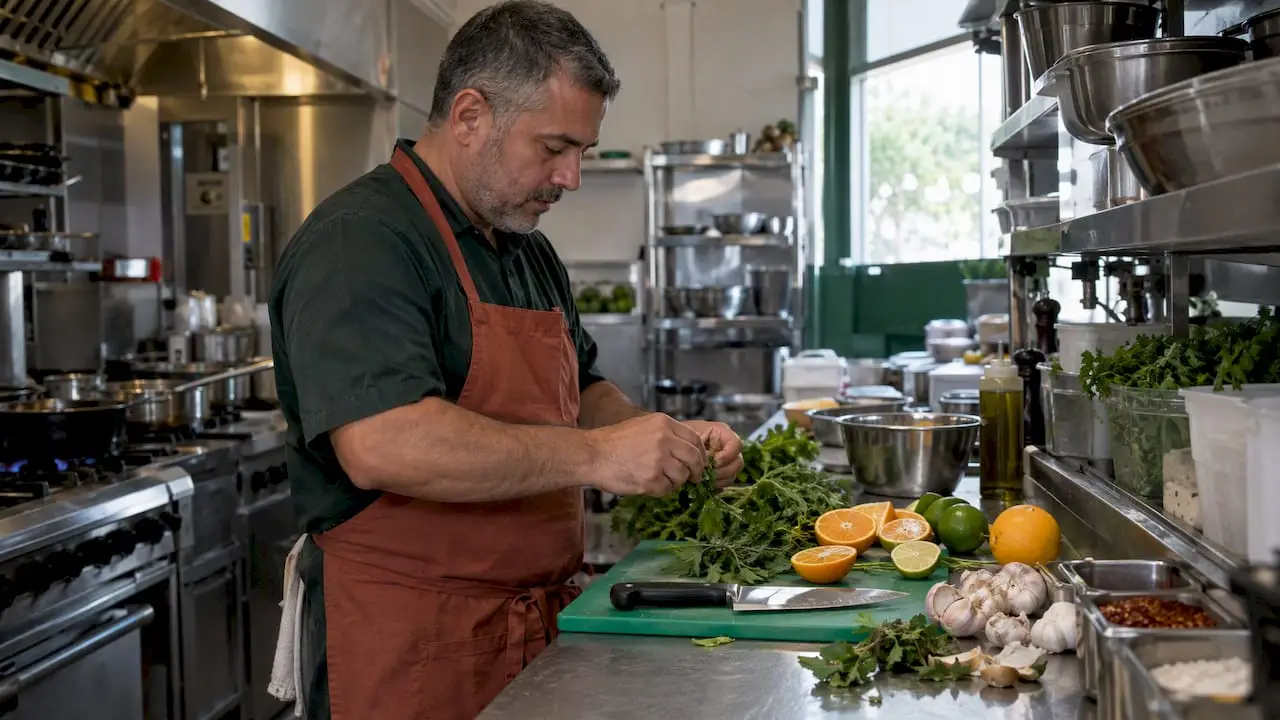
That is why we cook in small batches and never freeze our meals. A seasonal menu only makes sense if the food reaches you at its best, and frozen shortcuts erase the very thing seasonality offers. It is also why clients talk with the chef directly. A seasonal menu is a conversation: what is at its peak, what your household enjoys, what you cannot eat, and what you are tired of eating. A plan that does not reflect those answers is just a recipe list.
Our advice to anyone building their own plan is to keep it small. Fifteen dishes you actually cook beat sixty you saved and never opened. Repeat what works, and give yourself permission to swap out what does not.
— Virginia Jiha
When it makes sense to hand it to a chef
Seasonal planning saves time, but it still takes time: choosing dishes, shopping, cooking, adjusting. For many busy professionals and families, the plan is not the problem. The week is.
That is where a private chef service fits. Instead of building the rotation yourself, you tell the chef about your household, your dietary needs and your preferences, and the chef designs and prepares the menu for you. At VJ Cuisine, Chef Virginia personally designs and prepares every menu, and meals are made in small batches and delivered fresh across Miami, never frozen.
Here is how our offerings map to the situations in this guide:
- Weekly or ongoing dinners: our chef-crafted meal plans replace the rotation you would otherwise build and maintain. If you are weighing it, our guide to meal plan delivery in Miami explains how it fits into everyday routines, and our family meal plans article covers the household version.
- Parties and events: our boutique catering lets you hand over a seasonal menu for a gathering.
- A special evening: a private dinner at home puts a seasonal tasting menu on your own table.
- Gifts: handcrafted culinary gifts can be arranged through our main site.
Pricing depends on the plan, the number of people and the menu, so we do not publish a single rate. Reach out through the site to talk through your needs.
Common mistakes in seasonal menu planning
Planning too many dishes. A giant list becomes a chore. Cap each season at 20.
Treating the plan as a contract. The Whole U makes the point that meal prep does not need to follow a rigid schedule: it can be as small as washing produce or cooking a pot of grains, adjusted to your energy level. A plan should bend.
Ignoring local seasons. A menu copied from a northern blog will have you shopping for ingredients that are out of place in South Florida in July.
Forgetting guests and dietary needs. Build the constraints in first. Retrofitting them is where most hosts stumble.
Skipping the review. Without a quick end-of-season log, you repeat last season’s mistakes.
FAQ
How do you create a seasonal menu?
Start with what is at its best in your area, then choose 15 to 20 dishes that use those ingredients and fit your dietary needs. Place them in a four-week rotation with a flexible night or two. Review the plan at the end of each season and keep what worked.
What are the basic steps of menu planning?
Define your ingredients and constraints, choose a core set of dishes, arrange them into a repeating schedule, and review the results. For events, add a backward timeline from the moment guests sit down so prep and service stay manageable.
How often should you change a seasonal menu?
Four times a year is a good default, which is the idea behind most seasonal systems. In Miami you might also shift menus when the weather turns hot and wet or cool and dry, and for holidays. Small swaps in between are fine.
What should a seasonal catering menu include?
Two or three seasonal anchors, dishes that hold well, and a base menu that already works for common dietary needs. Tell your caterer about allergies and cross-contact concerns early, so the menu is designed around them rather than patched afterward.
Sources
- Meal Prep and Planning, The Whole U (University of Washington)
- What’s In Season, Fruit & Spice Park (Miami-Dade County)
- Plan what you eat, Health Canada
- Menu Planning Toolkit, City of Philadelphia
- Simplify Your Life with a Rotating Meal Plan, Organizing Moms
- Menu Cycles, Cycle 2