Farm-to-table dining means the menu is built around ingredients from nearby producers, harvested at peak season and served with minimal time between field and plate. Diners can expect rotating menus that follow the growing calendar, named farms listed alongside dishes, and sometimes event-style formats like communal farm dinners. The sections below walk through the experience types worth seeking out and a checklist for telling the real thing from a marketing label.
Key Takeaways:
- Short food supply chains and seasonality matter more for sustainability than simply focusing on distance traveled, as production practices often contribute the most emissions.
- Genuine farm-to-table restaurants typically name specific farms, frequently change menus with seasonal harvests, and have direct relationships with growers.
- Cost and limited scale are inherent challenges, as small-batch, direct-sourced ingredients are usually more expensive and harder to supply at large volume.
- Restaurant sourcing relies on logistics such as refrigerated transport and traceability systems to handle farm variability and maintain quality.
- Home farm-to-table experiences through meal plans, private dinners, and catering can mirror restaurant principles using small-batch, seasonal ingredients.
|
Bring Farm Fresh Flavor Home
VJ Cuisine creates fresh, small-batch meals, private dining experiences, and boutique catering for convenient dining at home. Explore VJ Cuisine |
What farm-to-table means and how restaurants define ‘local’
The term sounds simple, but restaurants apply it in different ways. The National Agricultural Library notes that federal programs typically use a threshold of a few hundred miles or within-state as a baseline definition for locally or regionally produced food. That number is a policy anchor, not a hard rule every kitchen follows. A restaurant in a rural county might source everything within 20 miles, while one in a dense city may need to reach further just to fill a menu.
Because the term has no single legal definition, chefs and menus use a handful of related phrases that carry slightly different meanings:
- Hyper-regional: sourcing tied to a specific county, valley, or even a single named farm rather than a broad radius.
- Seasonal: dishes built around what is being harvested right now, changing as crops come in and out.
- Short food supply chain (SFSC): fewer intermediaries between the grower and the plate, often just the farm and the kitchen.
Knowing these terms helps you read a menu the way a chef intends it, rather than assuming “local” always means the same distance.
Why seasonality and short supply chains matter more than mileage
The instinct to judge sustainability by distance traveled turns out to be an oversimplification. Research from City, University of London found that short supply chains do not automatically reduce greenhouse gas emissions. Consumer travel to farmers markets, inefficient last-mile delivery, and small-batch distribution can offset the benefits of a shorter supply route.
A life-cycle analysis reviewed on PubMed Central found that transport usually accounts for a minority share of a food item’s total carbon footprint, while production practices often drive most emissions. That reframes the whole conversation: how a crop is grown often matters more than how far it traveled.
For diners, this translates into a few practical takeaways:
- Peak-harvest produce tends to be picked closer to the meal, which chefs and growers associate with better flavor and less time for nutrients to degrade in storage.
- A menu built around what is ripe right now often reflects smarter sourcing than one obsessed with a mileage number.
- Delivery efficiency and how ingredients are aggregated before reaching the kitchen can matter as much as the distance from farm to door.
None of this means distance is irrelevant. It means seasonality and production method deserve at least as much attention as the miles traveled.
Farm dinners, tasting menus, and other ways to experience it
Farm-to-table dining shows up in several distinct formats, and each comes with its own rhythm and expectations.
- Farm dinners: Held directly on a working farm, these are usually ticketed, multi-course events with a fixed date and a set menu built entirely around what is ready to harvest that week. Reservations often sell out weeks ahead, and prices tend to run higher than a standard restaurant meal because they include the setting and the format, not just the food.
- Farm-based restaurants and tasting-menu spots: These operate year-round with menus that rotate weekly or even daily, naming specific farms on the menu itself. A tasting menu format gives the kitchen room to swap courses as supply shifts, without disappointing a guest expecting a fixed dish.
- Pop-ups and harvest festivals: Tied to a specific crop or season, such as a tomato harvest or a mushroom foraging window, these events often involve a guest chef collaborating with a grower for one night or one weekend only.
Farm dinners reward planning ahead since seats disappear fast. Tasting-menu restaurants reward flexibility, since the chef, not the guest, decides what the season allows. Pop-ups reward attention, since they rarely repeat.
How chefs keep menus consistent when supply isn’t
Farms do not deliver the same crop volume every week, and that unpredictability is the real operational challenge behind any farm-to-table claim. Industry reporting from Modern Restaurant Management describes tasting menus and rotating specials as a deliberate strategy for managing small-farm variability while keeping quality high and waste low. Instead of locking in a fixed dish months ahead, kitchens design around flexibility from the start.
That flexibility depends on logistics most diners never see. Industry analysis of food logistics argues that refrigerated short-haul transport, precise routing, and traceability systems are what make farm-to-table sourcing workable at any scale beyond a single weekly market stall. Without that infrastructure, “seasonal” becomes a marketing word instead of an operational reality.
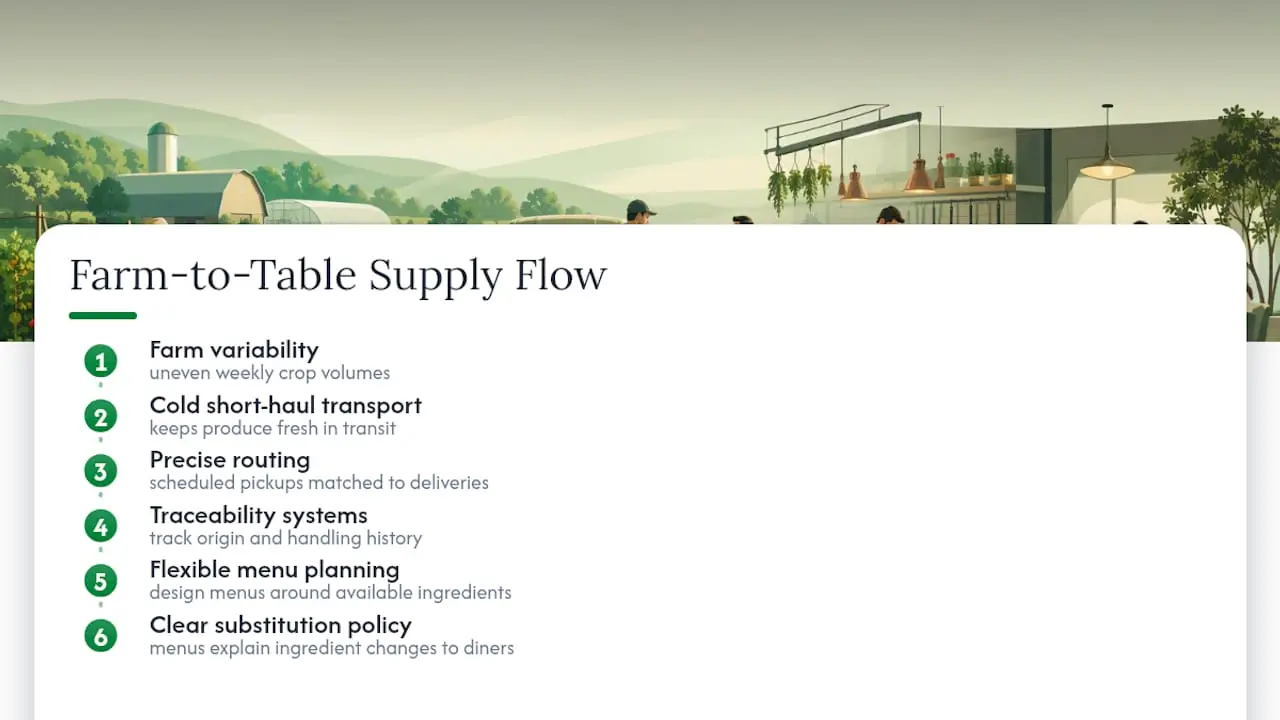
Chefs who take this seriously build direct relationships with a small number of farms rather than relying on a distributor catalog, and they communicate substitutions clearly instead of quietly swapping ingredients.
Pro Tip: When a menu lists a substitution policy or explains why a dish changed weekly, that’s a stronger signal of real sourcing than a menu that simply says “local” once at the top.
How to tell authentic farm-to-table dining from marketing language
A menu that name-drops “local” without naming a single farm is worth a second look. Authentic sourcing tends to leave a paper trail you can check before you book.
- Named farms: Dishes or menu footers list specific growers, not just a general claim of local sourcing.
- Frequency of change: Menus that shift weekly or with the season suggest real dependence on harvest timing.
- Direct-farm events: A restaurant hosting or partnering on farm dinners signals an existing grower relationship, not a one-off marketing push.
- Clear substitution policy: Staff can explain why a dish changed and what replaced it, rather than deflecting the question.
Before booking, it helps to ask a few direct questions:
| What to ask | Why it matters |
|---|---|
| Can I see a recent sample menu? | Shows whether dishes actually rotate with the season |
| Which farms do you source from? | Confirms named, checkable partnerships |
| How do you handle dietary substitutions? | Reveals whether the kitchen adapts thoughtfully or scrambles |
| Is transportation included for farm dinner events? | Clarifies logistics before you commit to a rural location |
A menu that never changes, uses “farm fresh” as a decorative phrase, or can’t name a single supplier is a weak claim dressed up as a strong one.
What farm-to-table sourcing means for local economies and farmers
Restaurants that buy directly from nearby growers change the math for small and mid-sized farms in a real way. A USDA Economic Research Service webinar on direct-to-consumer sales points to how important these channels are for small family farms, which often operate on thin margins and benefit from selling directly rather than through a long distribution chain with multiple markups.
For a farmer, a standing order from a restaurant means predictable demand for a crop that might otherwise go to a commodity buyer at a lower price. For a kitchen, it means a relationship where the chef can call ahead, ask what’s coming in, and plan a dish around it instead of ordering from a catalog month in advance.
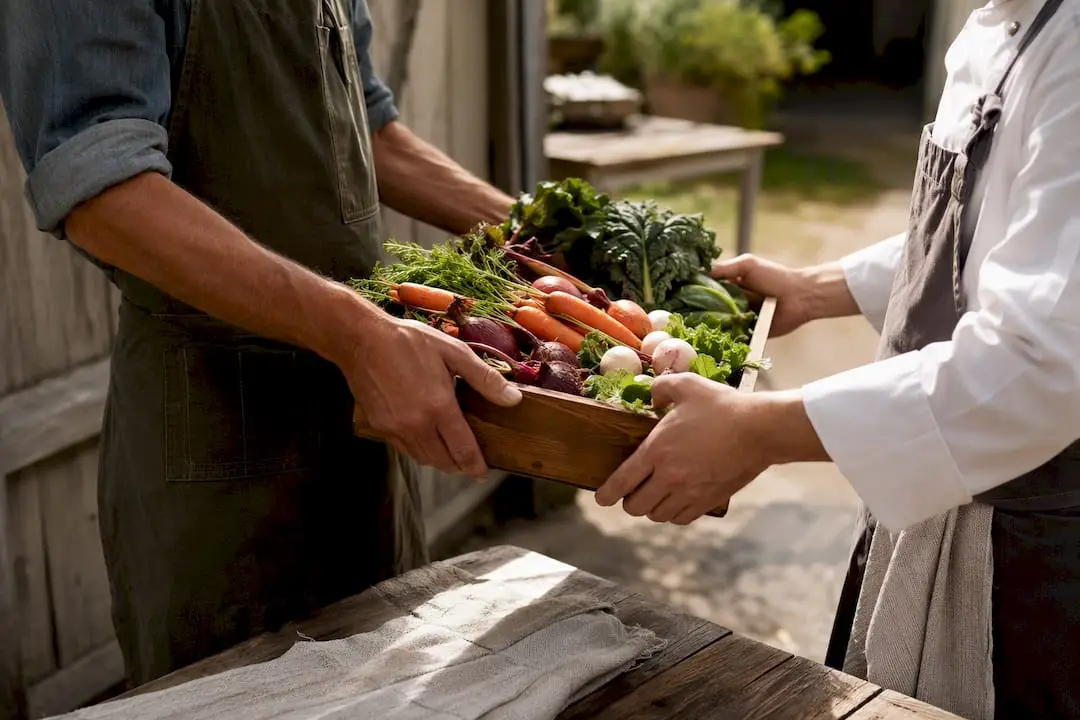
This kind of direct purchasing keeps more money circulating in the region instead of flowing to a national distributor. It also supports crop diversity, since a farm selling directly to a handful of restaurants has more freedom to grow unusual varieties that would never make it onto a supermarket shelf. A restaurant known for its farm partnerships often becomes an informal advertisement for the farms themselves, sending curious diners looking for the same produce at a market stall or CSA pickup.
The tradeoff is scale. Direct relationships work well for a single restaurant or a small group of them, but they cap out fast if a farm tries to supply too many kitchens at once without added infrastructure. That’s part of why so many farm-to-table restaurants stay intentionally small.
Where CSAs fit into the farm-to-table picture
Community-supported agriculture programs, where members pay a farm upfront for a season of produce, do more than feed households. They often function as the financial backbone that lets small farms commit to growing specific crops that restaurants then draw from.
A farm running a CSA already has a built-in customer base covering its early-season costs, which reduces the risk of also selling to one or two nearby restaurants at a fair price instead of a rock-bottom wholesale rate. Some kitchens go further and structure their own version of a CSA relationship, essentially becoming a large member of the farm’s season, guaranteeing a certain volume of produce in exchange for a menu built around it.
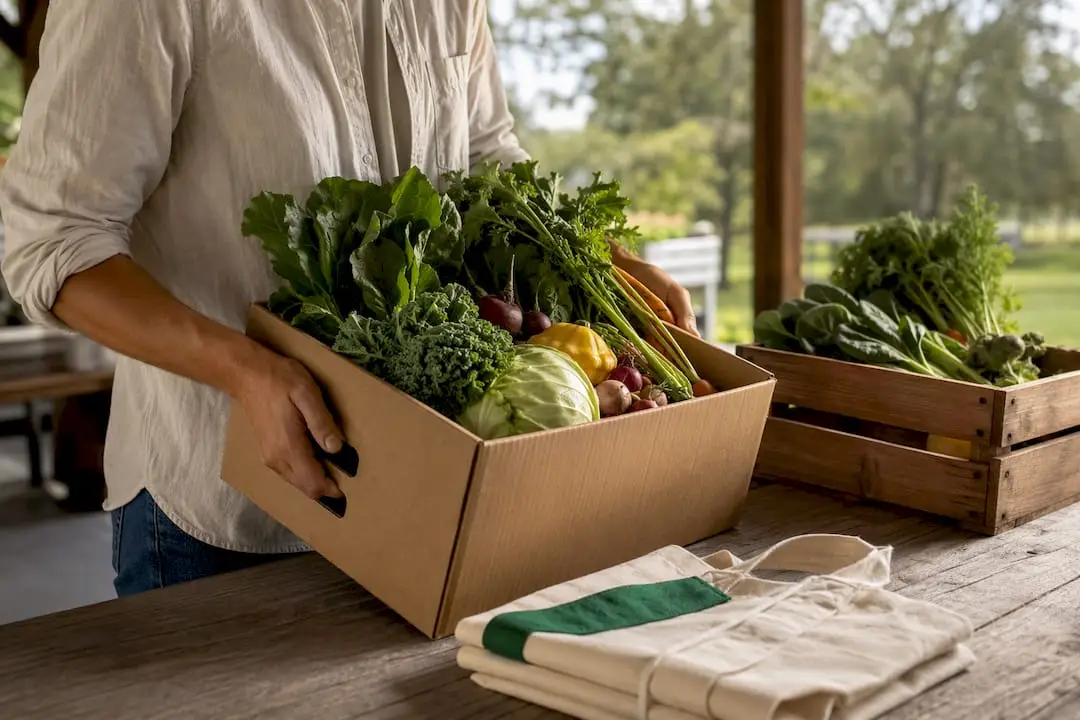
For diners, CSAs are also a way to experience farm-to-table principles without a restaurant reservation at all. A weekly box of whatever is ready that week is the same seasonal logic a tasting menu runs on, just delivered to a kitchen counter instead of a dining room. Farmers markets and CSA pickups often double as the informal meeting point where chefs and growers first strike up the relationships that later show up on a menu.
The real limits and criticisms of the farm-to-table movement
Farm-to-table dining has real limits worth knowing before you set expectations too high. Cost is the most obvious one: small-batch, direct-sourced ingredients rarely hit the price point of a commodity supply chain, and that difference shows up on the check.
Consistency is another. A critique of the food miles concept from the Asian Development Bank Institute points out that distance-based claims can mislead diners into thinking “local” automatically means “sustainable” or “better,” when the full picture depends on far more than proximity. A restaurant can source hyper-locally and still run an inefficient kitchen, and a longer supply chain can, in some cases, outperform a short one once production methods are factored in.
There’s also a scale problem. Genuine farm-to-table sourcing depends on small growers who cannot supply large volumes, which is part of why the term gets stretched and diluted once a restaurant group or chain tries to apply it across multiple locations. And because “local” and “farm-to-table” carry no legal definition, some restaurants use the language loosely, pairing it with a single seasonal special while the rest of the menu runs on standard commodity ingredients. None of this means the movement is hollow. It means the label alone isn’t proof, and the checklist earlier in this piece matters more than the phrase on the menu.
Bringing farm-to-table values into a home dining setting
Farm-to-table principles, freshness, provenance, and menus that follow the season don’t have to stop at a restaurant door. Every meal plan and private dinner is built around fresh, small-batch ingredients prepared to order, never frozen, drawing on a Haitian-Lebanese culinary heritage that treats seasonal cooking as a starting point rather than a constraint.
A private dinner or a weekly meal plan can carry the same values a farm dinner does: a chef who knows exactly what’s going into a dish, direct communication about ingredients and substitutions, and food made close to the moment it’s eaten rather than mass-produced ahead of time. For a busy household, that’s the farm-to-table experience translated into something that fits a weeknight.
Get farm-fresh flavor without leaving your kitchen
The appeal of farm-to-table dining, freshness, transparency, and a menu that actually changes, works just as well delivered to your door as it does at a farm dinner table. These meal plans, private dinners, and catering menus are built around small-batch, never-frozen dishes with attention to sourcing and seasonality similar to that of a tasting menu restaurant.
- Meal plans: weekly, chef-crafted dishes tailored to dietary needs, prepared fresh and delivered around a Miami schedule.
- Private dinners: a chef-hosted dinner at home, with a menu built around your preferences rather than a fixed script.
- Catering: boutique catering for smaller events, with the same small-batch approach as the meal plans.
To ask about menu customization or check dates for a private dinner, reach out to VJ Cuisine directly and describe what you’re looking for.
Sources
- National Agricultural Library (NAL): Local distance exhibit
- Modern Restaurant Management: Bridging the farm-to-table expectations with supply-chain realities
- City Research: Local, seasonal and SFSC analysis
- PMC article on food miles and lifecycle impacts
- Transcorp: Farm-to-table and why logistics makes it possible